

Why Is My Hair Falling Out When My Bloodwork Is Normal?
The Health Revival Show · Liz Roman & Becca Chilczenkowski · Guest: VJ Hamilton, Autoimmune Nutritionist
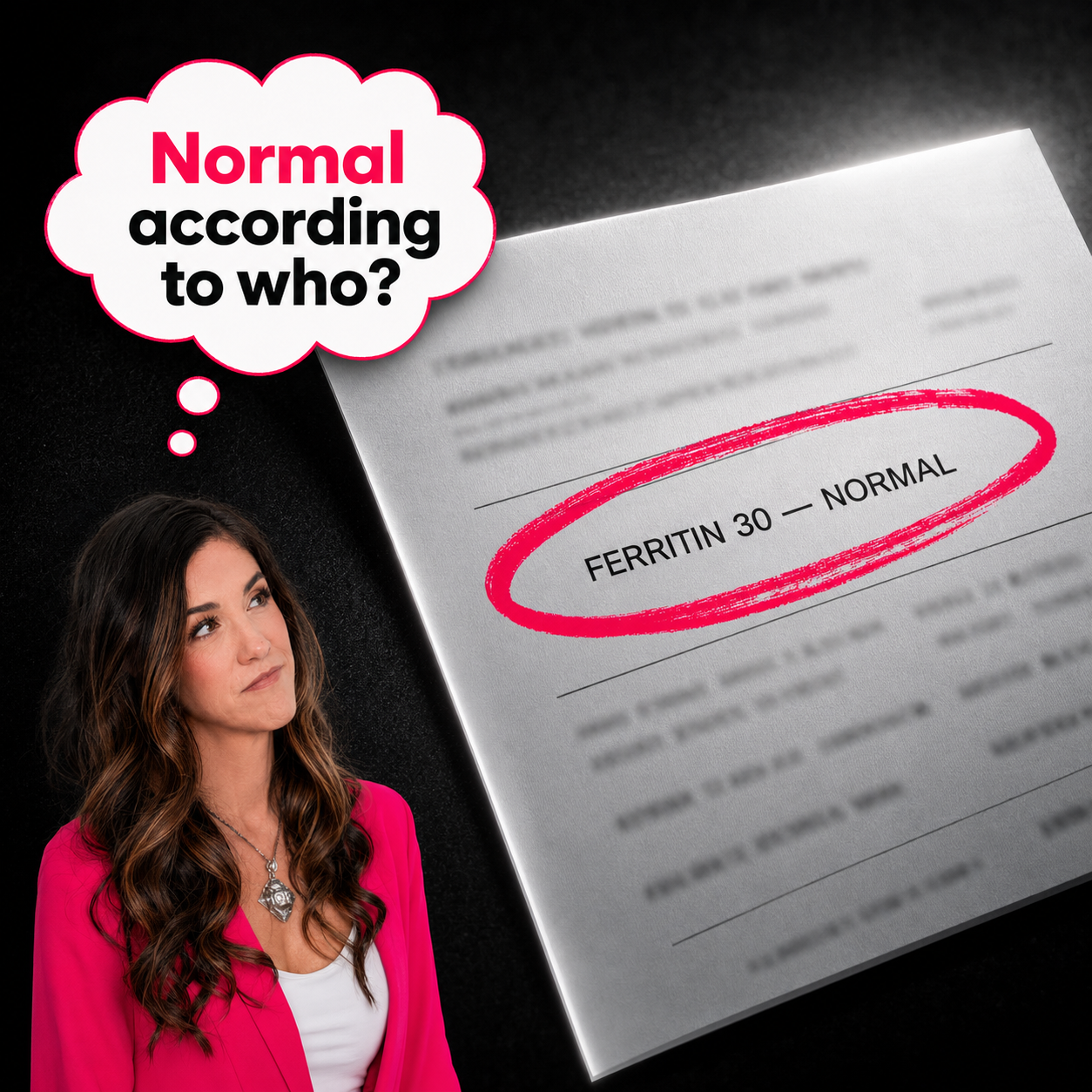
Hair loss with “normal” bloodwork usually means the reference range is too wide, not that you’re fine. FitMom’s practitioners routinely see ferritin in the 20s and 30s — flagged as normal, since most labs don’t alert until it drops below 15 — while the hair follicle, one of the most metabolically demanding tissues in the body, has already run out of the stored iron it needs to sustain growth.
Autoimmune nutritionist VJ Hamilton was diagnosed with alopecia areata at seven years old. She was handed a steroid cream and asked whether she was stressed. What followed was twenty-five years of hair loss, psoriasis, chronic fatigue, and inflamed joints — alongside a medical science degree in biochemistry and immunology, fourteen years in corporate accountancy, and a long file of lab results that all came back normal.
She has now been symptom-free for over a decade, and runs The Autoimmune Nutrition Clinic in the UK. In this episode she walks Liz Roman (@thepoopqueen) and Becca Chilczenkowski (@thehormonequeen) through what she actually assesses in a hair loss case — and why she starts with the gut nearly every time.
If a doctor has told you your labs are “normal” while your part keeps widening, the panel isn’t the whole story. Let’s look at what it missed.
Apply for a Root Cause Discovery CallWhy does hair loss show up before anything else does?
07:33Liz Roman: I was sharing with someone yesterday — her ferritin’s at a 30. And I’m like, okay, well, sadly your doctor’s never gonna look at this because it’s not below a 15. Which is just crazy. But this is going to be a key contributor to the hair loss that she’s experiencing. She’s in perimenopause, and this was her first time with functional medicine. Her OBGYN basically just said, well, it’s part of perimenopause, and when you’re finished bleeding, we can talk about hormones.
08:16Liz Roman: It’s just really sad. But we know that ferritin and iron play a huge role in hair loss — as well as the underlying autoimmune piece, the gut, other infections, thyroid, and being able to absorb our nutrients.
08:32VJ Hamilton: I see ferritin being extremely low with a lot of my clients, especially when I start working with them, and there can be numerous reasons for that. Firstly, we need iron for the cell division that is happening in the hair follicle. The hair follicle is hugely metabolically active, so it needs so much energy, and we need iron for that energy production in the follicle itself.
08:55VJ Hamilton: Outside of that, we need iron for our thyroid as well. If your thyroid isn’t functioning well, then it’s unlikely to be able to sustain long-standing hair growth. That’s what can happen a lot with people — they find that their hair starts growing, but they have these vellus, really fine hairs growing back rather than the hairs we all have on our head. A reason for that can be if their iron is low or their thyroid function isn’t working optimally. They’re just not able to sustain that growth.
Can your ferritin be low when your iron looks fine?
09:32VJ Hamilton: There can also be an issue with the storage of iron. Your ferritin levels can be low, but you can still have sufficient amounts of iron in your blood. What can happen is that, because your hair follicle is turning over these cells at such a fast rate to be able to create new hair for you, you really need those stores in order to sustain the hair growth.
09:57VJ Hamilton: So it’s looking at — is somebody absorbing iron? Are they eating enough iron in their diet? Do they have the co-factors to help with iron utilization? And is there some inflammatory component which is causing their iron not to be able to store in the way it should? It’s looking at that whole system and identifying where the problem might be.
10:21VJ Hamilton: What surprises me a lot when I’m working with clients is that they’re not actually eating a lot of the heme iron that we get from animal products. They’re relying on iron from plant-based products. Some people will probably do fine with that if they combine it with vitamin C and make sure they’re absorbing it. But other people, based on genetics and the environment in their body — the gut microbiome, whether there’s any toxicity, other things going on with cellular health — may need that heme iron that is so much easier for the body to use.
11:01Becca Chilczenkowski: I’ve seen that heme iron is 40 to 60 percent absorbed, and non-heme is only 10 to 20 percent.
11:05VJ Hamilton: Yeah, which I don’t think people realize.
Why does an autoimmune nutritionist start with the gut for hair loss?
11:40VJ Hamilton: I start with the gut, and I know that’s a very obvious place for us to look. But if there’s any inflammation in the gut, if there’s a buildup of certain gut bacteria, that can create an autoimmune response in the body. If somebody isn’t digesting their food very well, or has issues with their liver or gallbladder and isn’t digesting fats, then this can all be an issue — and it can have a domino effect.
12:11VJ Hamilton: Now, I didn’t have digestive symptoms — or I didn’t think I had, because I was that disconnected with my body at the time. But you can still have issues going on in the gut even if you don’t realize it.
12:44VJ Hamilton: Because if there’s inflammation in the gut, then it causes a loss of what we call immune tolerance, and that’s so key for the hair follicle — because the hair follicle is called an immune-privileged site. The immune system shouldn’t be able to penetrate it. But as our body loses tolerance, our immune system starts identifying our self-tissue. It could be your thyroid gland, it could be your hair follicle, it could be a nerve. As that breaks down, you become more reactive to things, which means you’re going to be more inflamed — and that often starts in the gut.
14:03VJ Hamilton: I also look at a client’s cellular health, which I review by doing an organic acids test. It’s not a diagnostic test, but it gives you a lot of insight into whether there is any toxicity in the body, or any yeast or bacterial overgrowth contributing to the inflammation. Going back to hair growth, you need a lot of energy — so if your cells aren’t producing energy in the right way, that’s going to affect hair growth as well.
Can you have a gut problem with no digestive symptoms?
15:05Liz Roman: I think a lot of people mistake that they don’t have digestive issues because they don’t have digestive symptoms — severe bloating, abdominal pain, constipation, diarrhea. Some people don’t think they’re constipated because they go every day, but they don’t really fully eliminate every day. I wanted to pause and highlight that, because when we do stool testing and look at the intestinal health markers, we can see a lot of digestive insufficiencies that would tell us why you’re maybe not absorbing all of those nutrients.
15:37Liz Roman: Like you mentioned — those fat-soluble vitamins. For some people, and this can be genetics too, they’re taking vitamin D but they’re not able to keep their levels stable without that support. We always go back and look at digestive capacity: stomach acid, bile acids, pancreatic enzymes. Just because you don’t have severe digestive symptoms, that is still the place we would look — because ultimately that’s the only way you’re able to absorb all the nutrients you need to support that very expensive metabolic process of producing and building hair.
Why is my hair growing back white?
16:58VJ Hamilton: You’re more likely to test zinc. Some people will have their hair growing back, but it grows back white. That might be a sign that there’s a copper deficiency. If I find copper is very low and zinc is very high, then we know we need to be thinking more about eating copper-rich foods. But often the case is that somebody is taking too much zinc, and that’s just causing the imbalance.
17:40VJ Hamilton: If you are eating more of a plant-based diet, you’re probably not getting sufficient amounts of copper. Even using a copper pan can be quite a nice way to get copper, or organ meat supplements. That was something I would generally always recommend to clients for hair growth — a good quality organ meat supplement, if my client wasn’t willing to eat organ meats.
Eleven years vegetarian, and the genetics that ended it
18:44VJ Hamilton: With hair growth, a lot of these nutrients which hair growth is reliant on are from animal products — and I was vegetarian for 11 years. At one point I ate a lot of quinoa. I ate quinoa every day, and it’s got a brilliant profile in terms of amino acids. My hair grew back when I ate quinoa, and I was doing a lot of running and resting. But it just wasn’t sustainable in the long term. And I actually started reacting to quinoa because I was eating so much of it.
19:38VJ Hamilton: I know some people who are vegetarian and they’re doing very well — no health issues, in optimal health. But with my genetics, I realize I have quite a need for animal-based nutrients. My body doesn’t convert vitamin A very well. I’ve got the MTHFR. I’ve always had an issue around B12, and B12 is such an important vitamin for your red blood cells and your circulation. It came up on a blood test result that I had enlarged red blood cells, and I’m sure that was affecting things when it comes to hair growth — because if the blood cells can’t get down the capillaries, you’re not getting the nutrients and the oxygen.
Do minoxidil, rosemary oil, and onion juice actually work?
21:19VJ Hamilton: In the UK, I’m a registered nutritionist with a governing body called BANT, so I can’t recommend anything like minoxidil. However, I will recommend clients go see a dermatologist or a trichologist. Minoxidil can help with circulation — it helps with vasodilation, and it can help hair growth in the scalp, so I can see the benefits of that. But for some people, if that’s not the root cause — if it’s more to do with oxidative stress or inflammation — then that might not be the right approach.
24:03VJ Hamilton: I can recommend things like rosemary oil, which is an antioxidant, or black seed oil if I feel histamine might be an issue. There are some nice combined scalp oils coming out now. They’re almost promoted as being for hair, but when you look at the ingredients, they do have key antioxidants in them that can settle everything down.
24:26VJ Hamilton: One of the things I used to do on my own patches — which I do recommend to some clients, but I don’t think they really like using it — is onion juice. You can grate up an onion, or put it through a juicer, and because that has all the antioxidants in it, it’s almost doing the same job as rosemary oil. I used to do that on my patches, and I would swear by it back then. But it didn’t help me have that long-term growth that I’ve got now. That’s when I dealt with the chronic fatigue and the underlying cellular issues and the gut issues — that hair growth lasted, and it’s not come out again.
25:26VJ Hamilton: I really like red light therapy. It’s a nice thing to combine, and it’s easy — you can use it at home. I used to pay a fortune to go to a clinic in London, and they’d put a red light comb through my hair and charge me $300, and I could only afford five appointments. Now you can buy them and use them every day. They have been shown to help with cellular energy and mitochondrial health.
Topicals rent you results. Fixing the input is what makes them stay. Our practitioners run the full root-cause workup — ferritin storage, thyroid conversion, gut immune tolerance.
Apply for a Root Cause Discovery CallIs your workout making your hair loss worse?
26:44Liz Roman: You mentioned running a lot, and I know we have many listeners who think their six-days-a-week exercise is very helpful for their stress. They say it’s de-stressing them. But really, we know when we’re trying to fix underlying issues, it can become not such a eustress and more of a stressor.
28:03VJ Hamilton: I got to a point where I just couldn’t run anymore even though I wanted to. I’d turn up at a gym and go on the treadmill, or go out for a run, and I’d get about three minutes into running and I’d just be so done. I’d think, I literally need to walk out of here. I wish I could have been stronger with myself and just stopped, but I would try and push myself if I could.
28:25VJ Hamilton: Then I got into Pilates, and I think that was the best thing for me. I found weight bearing quite hard to start with — I had ganglions growing out of both wrists and I could hardly use them — but it was more gentle. Even then I’d be exhausted afterwards.
29:33VJ Hamilton: All I’d cared about was external validation for my whole life. I really didn’t know myself at all. It was gradually understanding who I am, what makes me feel good, that I deserve rest. I don’t need to constantly be pushing myself. I looked back at what I enjoyed doing as a child — I liked writing, reading, being in nature, riding a bike. So I started doing all those things. And it made such a big difference.
31:16Becca Chilczenkowski: We’ve had a number of clients either leave their jobs when they’re working with us, or get a divorce, and once they are out of that environment of stress, so many of their symptoms resolve. They did nothing different but get out of the environment that was stressing their body out so much.
31:52Becca Chilczenkowski: Women go through pregnancy and postpartum and don’t realize the massive deficiencies that creates. The sleep deprivation, the stress of a newborn — all of these things we think our body just bounces back nutritionally from, when there’s so much of a higher need during those times. Maybe it’s not that. Maybe you’re an accountant and it’s tax season. Those periods turn into trigger points where everything after has not been the same. It’s not that you’re still in it — it’s that you’re still deficient from what you went through.
How long does hair regrowth actually take?
33:06VJ Hamilton: With hair growth, I would say you’re looking at a minimum of three months, and that would be a fantastic result — and probably only if there aren’t other issues going on underneath. I’ve been working with some clients where it’s been two years, but they’re seeing hair growth. The majority of my clients are really starting to see progress around the six-month mark.
33:36VJ Hamilton: If they’ve lost all the hair on their head — and a lot of my clients come to me with patchy hair loss like I did — that can take a year to really get the full regrowth. The patches grow even though it looks like all the hair’s come out. It still is in patches. That’s how the immune system works. They’ll get some regrowth in different hair follicles. It just takes time.
34:11VJ Hamilton: Some clients come to me with gut issues, but they haven’t had a menstrual cycle in years, so we need to get that back and the hormones balanced, and then we might need to work on their cellular health. It’s step by step, and those things can take a long time. Just working on the gut can take six months or a year.
35:05VJ Hamilton: But I really have hope for everybody. If you have alopecia areata, the hair follicle is still there and it is still active to a certain degree. It’s just that the immune system is targeting it, and once you get everything back into balance, there’s no reason why the hair wouldn’t grow back. Every biological function you have — breathing, being able to see, all these things that are innately within our body — that’s what hair growth is as well. As long as it’s got all the components, and structurally the hair follicle is there, which it is with alopecia areata and most forms of hair loss other than the scarring type, you should be able to get the regrowth eventually when everything gets back into balance.
35:47VJ Hamilton: But the hair follicle is so sensitive to everything — to hormones, to nutrient deficiencies, to toxicity, to inflammation. If any of that’s going on, then it’s harder to get regrowth.
Do shampoo and water quality matter for hair loss?
38:12VJ Hamilton: What I often see is that clients will have some form of dermatitis as well as having alopecia, and it’s like the scalp membrane has been damaged. As a result, you can have an inflammatory response, potentially oxidative stress, and maybe certain bacteria contributing to that when the barrier is disrupted. So it’s just having something that has fewer chemicals in it. I like using apps on your phone to check the toxicity of certain shampoos.
40:22Liz Roman: Above all of this, I’m a huge believer that your quality of water is a huge driver. Because if you’re not filtering it very well, you have all those contaminants — the heavy metals, the chlorine, all that stuff — that’s just going to continue to irritate it. So I always take that foundational approach with skin overall: you can do all of these expensive topicals, but if you’re not supporting what you’re bathing in, and you’re not supporting what you’re eating and how you’re digesting and absorbing, I think you’ll continue to spin your wheels.
42:01VJ Hamilton: You can use filters for your showers. That can be a good thing, because anything disrupting the scalp can affect the hair follicle. Even though I always take an inside-out approach when it comes to hair growth — once that immune privilege goes in the hair follicle, or once it’s damaged the hair follicle, even if it’s not irreversible damage, that’s going to stop hair growth. The healthier your scalp, the healthier your hair follicle’s going to be as well.
Why do normal DHT labs not rule out DHT hair loss?
43:07Becca Chilczenkowski: Hair loss is blood flow. It is hormones. It is nutrients. It is inflammation. It’s what your body is experiencing at the follicle level. I think something a lot of people don’t realize is your hair follicle’s basically its own organ — it is experienced at a different level than what maybe your bloodstream is experiencing. A lot of people are like, well, I don’t have high DHT. You might not have high DHT in the bloodstream, but your hair follicle might be experiencing high DHT levels, which can cause hair loss.
43:53Becca Chilczenkowski: There’s so many things to evaluate and so many things that need support. It’s very individualized. There’s no one-size-fits-all where this is the product that works for everyone.
VJ Hamilton’s one message
44:44VJ Hamilton: Because the stress response is such a key area when it comes to hair loss — go back and remember who you are and what lights you up. A little exercise I did: I wrote down what I was doing on a daily basis, then I wrote down what I liked to do as a child, and then what I’m passionate about at this moment in time. I compared what I was doing daily to those other lists, and I realized I wasn’t doing anything on those other two lists. I gradually brought in things that lit me up, and spent time with the people who mean the most.
Frequently asked questions
What ferritin level causes hair loss in women?
There is no single cutoff, but FitMom's practitioners routinely see hair loss at ferritin levels between 20 and 40 — values most labs report as normal, since automatic flags typically don't trigger until ferritin drops below 15. Because the hair follicle divides constantly and burns iron to do it, it needs a stored reserve rather than a bare minimum to sustain growth.
Can low ferritin cause hair loss even if my iron is normal?
Yes. Ferritin measures stored iron, not circulating iron, and the two can diverge. Autoimmune nutritionist VJ Hamilton explains that you can have sufficient iron in your blood while your ferritin stores sit low — and because the follicle turns cells over so quickly, it draws on those stores. Low ferritin with normal serum iron is a common pattern in women losing hair.
Is alopecia areata caused by gut problems?
Often, yes. The hair follicle is an immune-privileged site, meaning the immune system is not supposed to be able to enter it. VJ Hamilton explains that gut inflammation causes a loss of immune tolerance, after which the immune system starts identifying the body's own tissue — thyroid, nerve, or hair follicle — as a target. She reviews the gut first in nearly every alopecia case.
Can I have a gut issue with no digestive symptoms?
Yes, and it's common. FitMom's Liz Roman notes that stool testing regularly reveals digestive insufficiencies — low stomach acid, poor bile output, weak pancreatic enzymes — in women reporting no bloating, pain, or irregularity. VJ Hamilton had no digestive symptoms herself. Without adequate digestive capacity, the fat-soluble nutrients hair growth depends on are never properly absorbed.
How long does it take to regrow hair after alopecia?
Three months is an excellent outcome and the realistic minimum. VJ Hamilton, who works clinically with alopecia, finds most clients begin seeing meaningful progress around six months, while full regrowth from patchy loss commonly takes a year or longer. Cases involving gut repair, absent menstrual cycles, or cellular health issues take longer still, because each layer has to be addressed in sequence.
Does minoxidil work if the root cause is inflammation?
It depends on the driver. Minoxidil works through vasodilation, improving circulation to the scalp, so it helps when blood flow is the limiting factor. VJ Hamilton notes that if the real cause is oxidative stress, gut-driven inflammation, or depleted ferritin, minoxidil may not be the right approach — and results tend to stop when the product stops.
Why is my hair growing back white?
Hair that regrows white can indicate copper deficiency. VJ Hamilton explains that copper is required for hair pigmentation, and that excess zinc supplementation is a frequent cause of the imbalance, since zinc and copper compete. When she finds high zinc alongside low copper, the correction is usually dietary — copper-rich foods, organ meats, or cooking in a copper pan.
Does rosemary oil or onion juice actually regrow hair?
Both supply antioxidants that can calm scalp inflammation, and VJ Hamilton used grated onion juice on her own alopecia patches for years and saw regrowth from it. But she is direct that it did not produce lasting growth. Her hair only stayed once she resolved the chronic fatigue, cellular health, and gut issues underneath. Topicals manage the scalp; they don't fix the input.
Key terms from this episode
- Ferritin
- The protein that stores iron. Ferritin reflects your iron reserves rather than what’s currently circulating, which is why it can be low while serum iron reads normal.
- Alopecia areata
- Autoimmune hair loss that appears in discrete circular patches. Alopecia totalis (all scalp hair) and alopecia universalis (all body hair) are more extensive forms of the same process.
- Immune-privileged site
- A tissue the immune system is structurally barred from entering. The hair follicle is one. When that privilege is lost, the immune system can attack the follicle directly.
- Immune tolerance
- The immune system’s ability to recognize your own tissue as yours. When tolerance breaks down, the body begins targeting self-tissue — thyroid, nerve, or hair follicle.
- Heme vs. non-heme iron
- Heme iron comes from animal products and is absorbed at roughly 40–60 percent. Non-heme iron comes from plants and is absorbed at roughly 10–20 percent.
- Vellus hair
- The very fine, short hair that often regrows first. Vellus hair that never matures into terminal hair can signal low iron or suboptimal thyroid function.
- Organic acids test (OAT)
- A urine test used to assess cellular health, mitochondrial energy production, toxicity burden, and yeast or bacterial overgrowth. Insight-generating rather than diagnostic.
- DHT (dihydrotestosterone)
- An androgen linked to pattern hair loss. Blood levels don’t necessarily reflect what the follicle is experiencing locally, which is why normal DHT bloodwork doesn’t rule it out.
- Scarring vs. non-scarring alopecia
- In non-scarring alopecia the follicle remains structurally intact, so regrowth stays possible. In scarring alopecia the follicle is destroyed and replaced by fibrous tissue.
- Eustress
- Stress that is adaptive and beneficial. Exercise is usually eustress — but in a depleted body with unresolved underlying issues, the same training load becomes a net stressor.
- MTHFR
- A gene affecting methylation. Common variants can impair processing of folate and B12, both of which matter for red blood cell formation and circulation to the follicle.
Sources & referenced
- The Autoimmune Nutrition Clinic — VJ Hamilton’s practice, articles, and the free Autoimmunity Recovery Plan guide
- BANT (British Association for Nutrition and Lifestyle Medicine) — the UK governing body VJ is registered with, referenced on scope of practice
- Alopecia UK — the charity VJ names in the episode
Your hair is the first thing your body stops paying for. If it’s going, something upstream is broken — and “normal” labs aren’t the answer to that.
Apply for a Root Cause Discovery CallFollow Liz Roman @thepoopqueen · Becca Chilczenkowski @thehormonequeen · VJ Hamilton @theautoimmunitynutritionist