

Why Does NAD Make Some People Feel Worse Instead Of Better?
The Health Revival Show — Lab Report
NORMAL RESULT: Low energy means low NAD. Take NAD, get energy back.
NAD makes some people feel worse because inflammation changes where it goes. The enzyme CD38 rises with inflammation and consumes NAD directly, so flooding an inflamed body with IV or injectable NAD can feed inflammatory pathways and spike adrenaline instead of producing energy. FitMom's practitioners lower inflammation and address gut function first, then introduce oral NAD precursors — order determines the result more than dose does.
Liz Roman (@thepoopqueen) and Becca Chilczenkowski (@thehormonequeen) break down what NAD actually does inside a cell, why the same supplement produces euphoria in one woman and a panic attack in another, and the specific order FitMom uses before NAD ever enters a protocol.
What NAD Actually Does Inside Your Cells
01:08Liz Roman: We produce this in our body. It's made in every single cell, and it's essential for us to turn the nutrients that we're ingesting through food into usable energy. So NAD — if you think of it as the delivery truck that shuttles electrons around your cells' power plants, which are our mitochondria, they produce ATP. Think of this as your energy currency. If you don't have any delivery trucks running, no energy is getting made. And that's why a lot of people take this: because they think it's going to boost their energy.
01:40Liz Roman: But beyond energy, it is also required for DNA repair. It's the fuel for enzymes called PARPs that fix damaged DNA, and for activating a family of resilience genes called sirtuins.
02:37Liz Roman: Think of it like putting your truck together. You have to have gas. You have to have tires. You have to have brakes. You have to have a gear shifter. You have to think about all these other precursors to NAD as well.
Energy, Brain Fog, Aging: What NAD Status Actually Touches
07:27Becca Chilczenkowski: Energy and fatigue — it is a direct line to mitochondrial ATP output. Brain fog and cognition is a big piece too, because the brain is one of the most energy-hungry organs in the body, so it's especially sensitive to NAD status.
07:44Becca Chilczenkowski: Cellular aging and DNA repair capacity. Our cells are constantly deciding whether they need to repair themselves, kill off themselves, or regenerate. How you age and how well you age has a lot to do with how well your body recognizes those things. We think of telomere length — every time there is a large stressful event, that telomere gets shorter and shorter, and if it's not repairing and replicating well, we don't age well.
09:29Becca Chilczenkowski: And then muscle function and exercise recovery. Exercise intolerance is becoming more and more commonplace — people work out, they get extremely sore, they're more tired afterwards. That has a lot to do with how well your cells are able to repair and regenerate.
Why Your NAD Is Low: CD38, Alcohol, And Inflammation
09:55Liz Roman: Let's talk about why it declines. Number one, age — this is the most talked about, and it is the largest driver of the decline of NAD. But chronic inflammation drives up something called CD38, an enzyme that gets more active with age and inflammation, and it directly consumes NAD.
10:24Liz Roman: CD38 is basically the NAD thief. So the more inflamed that you are, the more NAD gets burned up just by managing that enzyme. And this is the big reason why we have to be careful of dumping a ton of NAD at once through an IV or an injectable. If they're inflamed, where does the NAD go? CD38 snatches it up, and it can actually drive inflammation even higher. Let me repeat this again: NAD can drive your inflammation higher if you're already inflamed. So I don't think that it's a great place to start.
11:01Liz Roman: Alcohol metabolism directly uses up NAD as a cofactor, so if you're drinking regularly, that's going to drain your NAD. Chronic stress, poor sleep — all of this is going to inflame us as well. And then everything we're exposed to every day with toxins and UV exposure is putting a load on the body that your body is trying to detoxify. Even though age gets a lot of the blame, inflammation and alcohol use are going to be more damaging to NAD than just your aging.
The Three Mitochondrial Genes: SIRT1, PGC-1α, And TFAM
12:47Becca Chilczenkowski: SIRT1 is the sensor. NAD activates it directly. It's the switch that kicks off this repair and energy-building process. Mechanically, SIRT1 is a deacetylase — it strips off switches, which are acetyl groups, on other proteins to wake them up, and NAD is literally the fuel that burns to do that. It's the same pathway tied to calorie restriction and longevity research. So no NAD, no fuel for the sensor, and the whole downstream chain stalls before it even starts.
13:51Becca Chilczenkowski: PGC-1α, the PPARGC1A gene, is the construction manager. Once SIRT1 flips the switch, PGC-1α tells the cell to build more mitochondria and upgrade energy metabolism. It partners with co-factors like NRF1 and PPARγ to put the full order together, covering both new mitochondria and better-functioning existing ones.
14:24Becca Chilczenkowski: That has to happen, or else your cells don't work well, and you're exhausted, and you can't recover from exercise, and you can't lose weight, and you're constantly inflamed. All of this comes back to a cellular mitochondrial problem. When we're talking debilitating fatigue that nothing touches — that is a cell problem.
14:52Becca Chilczenkowski: And then there's TFAM. TFAM is the foreman on the site. TFAM physically executes the replication and assembly of new mitochondrial machinery once PGC-1α gives the order. It binds directly to mitochondrial DNA, both protecting it and driving its replication. It's the step that determines whether you get new fully functional power plants, not just more mitochondrial bulk.
Why Raising NAD Doesn't Automatically Mean More Energy
15:32Becca Chilczenkowski: Raising NAD levels doesn't mean that you're going to have more energy. If you have impairments in all of these genes, you have a whole downstream activation issue. If someone has reduced function of SIRT1, PGC-1α, or TFAM, they might not get the full expected benefit of NAD alone — especially if they are inflamed.
15:54Becca Chilczenkowski: If you are a good metabolizer, meaning your whole metabolic health is in a good spot and you have a low inflammation state, NAD works wonders. It makes you feel amazing. If you are unhealthy, it fuels all the negatives, and so this is why we don't just put it in place.
16:38Becca Chilczenkowski: NAD is the raw resource. The whole rest of the system has to work properly, and that is why so many people put it in and they either don't feel better, or we see the opposite — they get anxiety because it spikes adrenaline. Their body can't handle it, they can't clear it, and now they're in this hypervigilant state. We see it flare autoimmune conditions. I see it flare anxiety and mood issues, because you're flooding a system that can't facilitate it. So you need it — not saying you don't need it — but is it the right time?
NR vs NMN vs Niacin: The Four Oral Precursors
17:32Liz Roman: NR, which is nicotinamide riboside, is the most studied with the strongest current head-to-head data. A 2026 peer-reviewed study out of Haukeland University in Norway directly compared NR and NMN at the same dose in the same participants. Nicotinamide riboside raised blood NAD by 161 percent after eight days versus 67 percent for NMN. It's the compound behind Tru Niagen, one of the most clinically tested NAD products on the market.
18:13Liz Roman: Then you have NMN — nicotinamide mononucleotide — which is metabolically a closer step to NAD than NR. There's a growing human trial base, but in recent head-to-head data it suggests it's less efficient at raising circulating NAD than NR. This is worth noting, because when you look at supplements out there it's going to tell you that it's just NAD, but if you look at all of the ingredients you're going to see combos.
18:52Liz Roman: Then we have nicotinic acid, or niacin. This is the original, oldest studied precursor going back decades. It's the same molecule used in high-dose niacin therapy for cholesterol, with the flushing side effect — we try to use the non-flushing versions, because that can be quite uncomfortable. There's interesting research from a 2025 Nestlé study: gut bacteria actually convert both NR and NMN into nicotinic acid, and that conversion step may be doing more of the work raising circulating NAD than they previously thought. So gut health may also determine how well some of these supplements are going to work for a given person.
19:33Liz Roman: Why does this person take it and feel fantastic, and this person takes it and feels nothing? Many people, when we're layering this into their protocols, are already through the majority of the gut work and lowering inflammation.
19:47Liz Roman: And then you have nicotinamide. This is technically a precursor, but it's the weakest of these four, so it's not one we're typically looking at. There is a well-documented catch: at higher doses it can inhibit SIRT1 activity — the exact enzyme NAD is supposed to be activating.
Tried NAD and felt nothing — or felt worse? That's not failure. That's data about what's upstream.
Book a Root Cause Discovery CallDo NAD Patches Work? The 663-Dalton Problem
21:27Liz Roman: Your skin barrier and your absorbability — the likelihood of you being able to absorb the things you're putting on your skin — is kind of like the gut. It is a barrier. So if your gut's messed up or your skin's messed up, and obviously if there are histamine issues, we'd want to take that into account before considering putting something on that can be irritating.
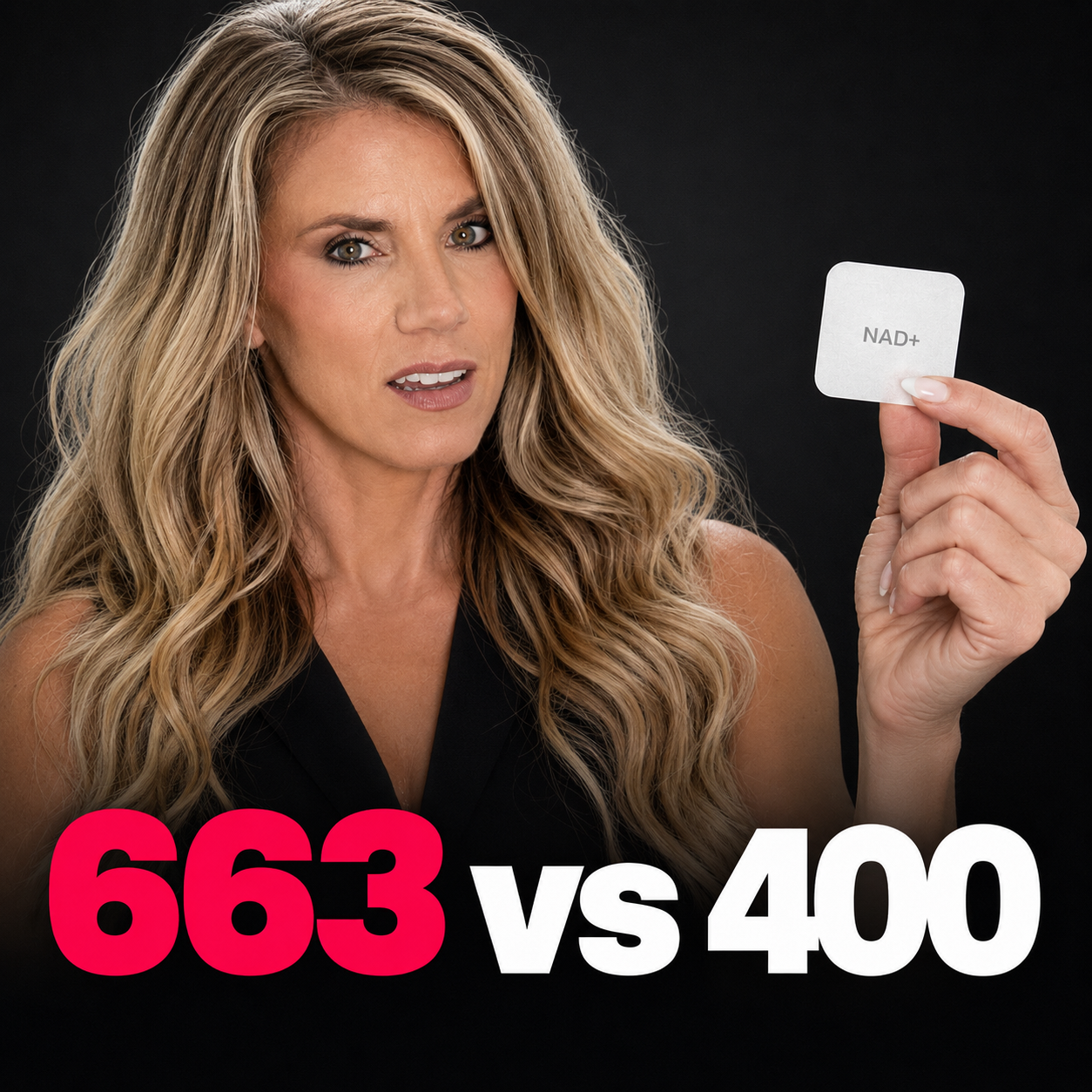
22:03Liz Roman: You can't really argue with science. The science problem is that it can't even get through the lipid bilayer. NAD is a large charged molecule — it's 663 Daltons. The general rule of thumb for a molecule to reliably cross intact skin is under 400 Daltons. So this is well above 1.5 times that ceiling, and its electrical charge makes it even harder to passively cross the skin's lipid barrier, the stratum corneum. Even NAD's precursor molecules, which are smaller — around 255 Daltons — still face absorption limits through intact skin without help. So I would say a patch is not something that I would go for.
23:03Becca Chilczenkowski: There's new technology coming out — nanoparticle technology is very up and coming, and liposomal-enhanced technology is also emerging in pharma research, and could absolutely change what we are saying right now. But it begs the question of whether you're actually absorbing any of it, because those NAD patches are not cheap, and I don't believe there's a ton of research backing them yet.
IV And Injectable NAD: Who Should Not Do It
24:20Becca Chilczenkowski: Let's talk about the injectable, because I think that's the big one. Yes, it does bypass digestion entirely, which is huge, because it directly puts it into the tissue or the bloodstream. Much higher effective delivery, since it skips the digestive conversion bottleneck.
25:03Becca Chilczenkowski: Injectable or IV NAD is well-documented to cause flushing, chest or throat tightness, anxiety or restlessness, nausea, and dizziness. And it is not random, because NAD causes blood vessel dilation and smooth muscle contraction, and the intensity of that reaction is directly tied to infusion speed. Slower infusions are better tolerated — but if someone had a rough IV NAD experience, it was likely infused too fast, or you injected too much at once. People who already run a reactive or dysregulated nervous system are not the people that I would recommend this to. Absolutely not.
25:48Becca Chilczenkowski: It can fuel certain pools of these inflammatory coenzymes like CD38 and NMNT. NAD doesn't necessarily go exactly where you want it to go — it's going to go where the body takes it up. So if you have a lot of CD38 in the body, a lot of NMNT in the body, these inflammatory producers, you can fuel that. I have seen this multiple times. I've seen it in clients where they react to the NAD.
What FitMom Does Before NAD Enters The Protocol
12:10Liz Roman: We wouldn't want to introduce this right away if we know that person is coming in inflamed, high A1C, insulin resistance, not going to the bathroom every day, having a lot of digestive issues. We want to lower the inflammation in the body. We want to support opening up the drainage and detox pathways before we bring this in.
26:20Becca Chilczenkowski: If I were to make a recommendation off of this: start with oral precursors. Gentler onset, easier to see how you personally tolerate it before going further. If you have a nervous system or sensitivity issue, I probably would not be bringing this in first. This is not my first go-to. When someone comes in and they're a sensitive client, or a really dysregulated client, NAD is not at the top of my list. There are so many other things that we would be working on to help support them and their energy levels.
26:49Becca Chilczenkowski: Urolithin A, for example, is a lot more gentle. It tends to clean up the oxidative stress. SS-31 is another one that cleans up some of that oxidative stress that otherwise could be problematic when you bring in NAD. So there's a lot that I would be considering before having this come into the picture.
27:08Becca Chilczenkowski: And if you're not responding to it how you want to, that might be a good clue that there are some genetic things going on, or potentially some barriers or other things that aren't an NAD problem. This isn't everyone's problem that has energy issues. There's a lot we have to consider around gut health, immune health, lifestyle habits. Maybe we don't have an NAD problem, and we're trying to fix an energy problem with something that's not actually the piece of the puzzle.
Frequently Asked Questions About NAD
Why does NAD make some people feel worse instead of better?
NAD makes some people feel worse because an inflamed body redirects it. The enzyme CD38 rises with inflammation and consumes NAD directly, and excess NAD can spike adrenaline in a dysregulated nervous system. FitMom's practitioners see this present as anxiety, restlessness, or an autoimmune flare rather than energy. The problem is usually sequencing, not the molecule itself.
Can NAD supplements actually increase inflammation?
Yes, in an already-inflamed body. CD38 is an enzyme that becomes more active with age and inflammation and consumes NAD directly, so a large dose delivered fast can feed inflammatory pathways instead of energy production. Liz Roman of FitMom describes CD38 as the NAD thief, and recommends lowering inflammation before introducing NAD rather than after.
What is CD38 and why does it matter for NAD?
CD38 is an enzyme that consumes NAD directly and becomes more active with both aging and chronic inflammation. FitMom's practitioners treat it as the reason two women can take identical NAD doses and get opposite results: the more inflamed woman burns her NAD managing CD38 before it ever reaches her mitochondria. Stabilizing CD38 comes first.
Do NAD patches actually work?
The physics argue against them. NAD is a large charged molecule at roughly 663 Daltons, while the general threshold for a molecule to reliably cross intact skin is under 400 Daltons. Its electrical charge makes passive movement through the stratum corneum harder still. Even NAD precursors, at around 255 Daltons, face real absorption limits without delivery assistance.
Is NR or NMN better for raising NAD levels?
Two 2026 trials disagree, and dose explains much of it. A small phase I crossover at Haukeland University Hospital found nicotinamide riboside raised blood NAD 161 percent versus 67 percent for NMN at 1,200 mg daily. A larger Nestlé Research trial of 65 adults found NR and NMN comparable at 1,000 mg over 14 days.
Why does IV NAD cause flushing, chest tightness, and anxiety?
Because NAD causes blood vessel dilation and smooth muscle contraction, and the intensity of that reaction tracks directly with infusion speed. Becca Chilczenkowski of FitMom notes that a rough IV NAD experience usually means it was infused too fast or dosed too high. Slower infusions are better tolerated, and reactive nervous systems tolerate them worst.
Does gut health affect how well NAD supplements work?
Substantially. Nestlé Research published evidence in 2026 that gut bacteria convert both NR and NMN into nicotinic acid, and that microbial conversion step appears to drive a meaningful share of the rise in circulating NAD. FitMom layers NAD precursors in only after most gut work is done, because oral precursors must survive digestion and several conversion steps.
Who should not start with NAD?
Anyone actively inflamed, anyone with a reactive or dysregulated nervous system, and anyone with unresolved gut issues, high A1C, or insulin resistance. FitMom's practitioners lower inflammation and open drainage and detox pathways first, then introduce gentle oral precursors. Urolithin A and SS-31 are often used earlier because they clear oxidative stress rather than adding fuel to it.
Key Terms
- NAD (nicotinamide adenine dinucleotide)
- A coenzyme made in every cell that shuttles electrons to the mitochondria so nutrients become usable energy (ATP). Also required for DNA repair and for activating sirtuins.
- CD38
- An enzyme that directly consumes NAD and becomes more active with aging and chronic inflammation. The primary reason an inflamed person gets less benefit from the same NAD dose.
- SIRT1
- A sirtuin gene that acts as the cell's repair sensor. NAD activates it directly. SIRT1 is a deacetylase — it strips acetyl groups off other proteins to switch them on.
- PGC-1α (PPARGC1A)
- The gene that orders construction of new mitochondria and upgrades energy metabolism once SIRT1 flips the switch. Also activated by exercise.
- TFAM
- Mitochondrial transcription factor A. Binds mitochondrial DNA and physically executes replication and assembly of new mitochondrial machinery — determining whether new mitochondria actually function.
- PARPs
- Enzymes that repair damaged DNA. They run on NAD, which is part of why NAD is depleted faster under high oxidative and toxic load.
- NR (nicotinamide riboside)
- An oral NAD precursor with the largest human trial record. Enters cells via nucleoside transporters, requiring fewer conversion steps than NMN.
- NMN (nicotinamide mononucleotide)
- An oral NAD precursor one metabolic step closer to NAD structurally, though it must generally convert to NR before entering most cells.
- Nicotinic acid (niacin)
- The oldest studied NAD precursor. Known for a flushing side effect at high doses. Now understood to be produced in the gut when bacteria convert NR and NMN.
- Nicotinamide (Nam)
- The weakest of the four precursors for sustained NAD elevation. At high doses it can inhibit SIRT1 — the enzyme NAD is meant to activate.
- Stratum corneum
- The outermost lipid barrier layer of skin. The reason large or charged molecules cannot passively pass through a transdermal patch.
- Dalton
- A unit of molecular mass. The working threshold for reliable passive absorption through intact skin is roughly 400 Daltons; NAD is about 663.
- Urolithin A
- A gentler mitochondrial support compound that clears oxidative stress, often used before NAD in sensitive clients.
- SS-31 (elamipretide)
- A mitochondria-targeted peptide used to reduce oxidative stress that would otherwise be aggravated by introducing NAD.
Sources
- Berven et al., NAD-brain phase I pharmacokinetic trial, Haukeland University Hospital / University of Bergen, published in iScience (Cell Press), 2026 — NR vs NMN head-to-head, 1,200 mg/day. View study
- Christen et al., "The Differential Impact of Three Different NAD+ Boosters on Circulatory NAD and Microbial Metabolism in Humans," Nestlé Research / Nestlé Health Science, Nature Metabolism, January 2026 — 65 adults, NR vs NMN vs nicotinamide, gut microbial conversion to nicotinic acid. View study
- Chellappa et al., "NAD precursors cycle between host tissues and the gut microbiome," Cell Metabolism, 2022 — foundational work on microbial conversion of NAD precursors. View study
Stop buying solutions to a problem nobody has diagnosed. We run the labs, find what's actually driving the fatigue, and build the protocol in the right order.
Book a Root Cause Discovery Call