

Why Did My GLP-1 Stop Working If I'm Barely Eating?
Lab Report — Reason Your GLP-1 Stalled
Result:
NORMAL — RECEPTOR BURNOUT, NOTHING TO DO
Actual:
YOUR FOUNDATIONS WERE NEVER FIXED
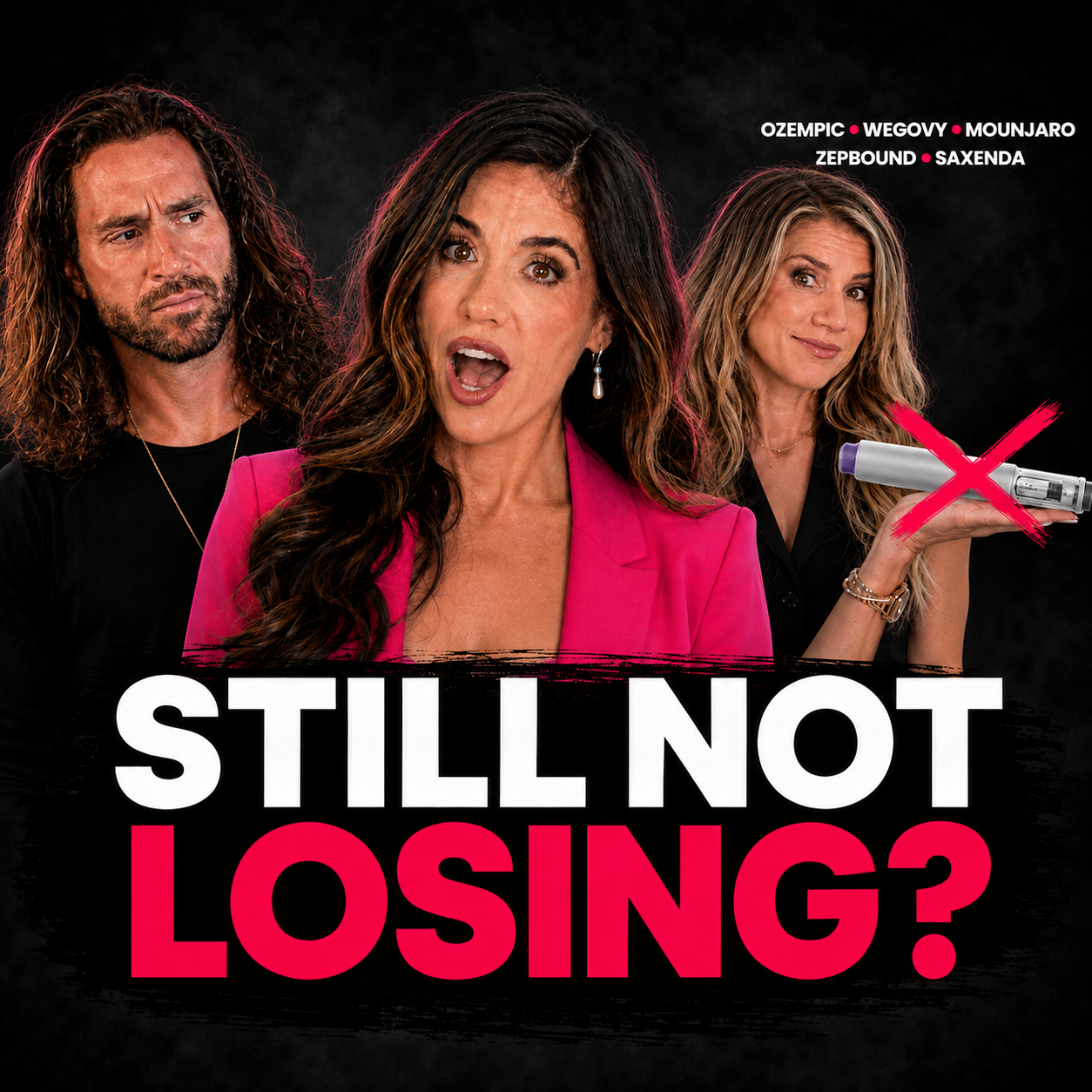
Most GLP-1 plateaus are not receptor burnout. On The Health Revival Show, peptide educator Hunter Williams explains that tirzepatide and retatrutide both suppress appetite and increase calorie burn, so the body sits in a compounding energy deficit and starts responding like it is starving — thyroid output drops, neuroendocrine hormones shut down, and micronutrients fall off. FitMom's practitioners restore reproductive hormones, thyroid, and mitochondrial function first; the same dose usually starts working again.
Guest: Hunter Williams, peptide educator (hunterwilliamshealth.com). Hosts: Liz Roman (@thepoopqueen) and Becca Chilczenkowski (@thehormonequeen), functional health practitioners at FitMom. Episode published 14 August 2026.
Your labs came back “normal” and you’re still stuck.
A Root Cause Discovery Call is where a FitMom practitioner looks at what your GLP-1, your thyroid and your hormones are actually doing together — instead of one at a time.
Apply For A Discovery CallFull conversation — edited transcript
Who is Hunter Williams, and why does he teach peptides?
01:48 Hunter Williams:
I got into this space to solve my own problems. I'm not medical whatsoever — my degree is in finance. But I was an athlete. I played Division I football at Wake Forest, so about sixteen or seventeen years of football total. Then I hit twenty-four, twenty-five, and I just did not feel like myself. Anxious. Depressed. Aches and pains. And I was healthy — trained all the time, ate well, did all the biohacking stuff.
I did my blood work and found out I basically had zero testosterone. Across different tests I was somewhere between eighty and a hundred and fifty total. A lot of people don't know that's not uncommon with a history of concussions. I played linebacker, so I hit people thousands of times, but I never had a diagnosed concussion, never blacked out. It turned out my pituitary gland just wasn't making enough hormone to synthesize into testosterone.
So I got on testosterone replacement, and like most people, that opened the door to peptides. This was 2020, 2021 — nobody was talking about them, and almost no doctors were. You did your own research. I started posting videos on YouTube, basically as a video journal. Got kicked off, went back on, got kicked off again. That's how I got here.
05:32 Becca Chilczenkowski:
Clinical experience with actually working with people, in my opinion, almost trumps research — because it's the actual person sitting in front of you versus a controlled experiment with a specific set of participants. Sure, it can apply. But not to everyone.
What happens when a GLP-1 stops working after a year or two?
06:13 Becca Chilczenkowski:
I'd love to start with the biggest one right now, which is GLPs. Something a lot of people are experiencing now that these have been out for a while: it's not working anymore. They're not losing weight, or they're starting to gain while on them. Can you speak to this receptor burnout idea?
07:58 Hunter Williams:
The question is, do the GLP-1 receptors burn out? Do you use these peptides and the body just builds a tolerance where they don't work? I don't think that's necessarily the case. There's a dose-response curve where you get to a certain dose and it becomes less and less effective over time, which is why I'm a fan of infrequent cycling — even one or two months out of the year off, so the body reacclimates and you get a better response at a lower dose.
But ultimately the best way to explain it is the body is in an energy deficit. We've never had a peptide or a drug so powerful at raising how much energy we're expending while also inducing a calorie deficit by suppressing appetite.
Why does a GLP-1 plateau look exactly like starvation?
09:23 Hunter Williams:
If you did that through the same means of starving yourself over an extended period of time, what's going to happen? It would be no different than if you starved yourself for a year. Eventually a lot of different things go wrong with your health.
That's what's playing out on a big scale. People are essentially starving themselves and burning more calories at the same time. So you run into neuroendocrine hormone shutdown, thyroid shutdown, or micronutrient deficiencies where they're just not getting what they used to. Things start to go awry.
That's what no one's talking about. Everyone wants to say the drug stopped working, or there's a problem with the drug. I don't think the peptide is to blame. Before GLP-1s came out, people lost weight without them — nobody had a GLP-1 deficit.
11:12 Liz Roman:
One of the things we talk about a lot is keeping the dose in a range that still lets you absorb nutrients and not be so sick that you're just not eating. When I first started semaglutide at a low dose, I was using it to get into deep fasting and autophagy, which is great, but the nausea meant I had no chance of eating. And you see it in your community too — people lose fast, but it's not just fat. They lose a ton of muscle, and then wonder why they're malnourished, or why their labs are suddenly showing hypothyroidism.
Is retatrutide better than tirzepatide for a stressed-out woman?
13:26 Hunter Williams:
This might be an unpopular opinion. All the social media stuff is reta, reta, reta — reta is better. I don't think that's always the case.
If you look at women roughly thirty-five to sixty, that's usually the biggest avatar for autoimmune disease, chronic cortisol dysregulation, or hormone deficiency from peri- or post-menopause. Retatrutide can be so powerful at creating that energy deficit — suppressing appetite while increasing caloric burn.
So take a person whose nervous system is very sympathetically driven, basically from chronic stress. They probably have cortisol issues. Even if they're not obese they probably have background inflammation from the stress, and if they're not sleeping well that adds more. A lot of these people are living a healthy lifestyle. For that person, a thousand times out of a thousand I will say tirzepatide, every day. Because if you ramp up their nervous system even more, drive HRV down and resting heart rate up, they're almost always not going to respond well even if they're losing weight.
Bad responses to retatrutide are maybe one in four or five. With tirzepatide it's maybe one in nine or ten, and that's being generous.
How fast should you actually be losing weight?
16:50 Hunter Williams:
Everyone wants maximum fat loss as fast as possible. Everyone wants to lose all the weight in thirty days. That's actually not what you want to do — that would be a bad thing, whether it's tirzepatide or retatrutide. One to two pounds per week is really as much as you want, to make sure you're insuring against hormone shutdown or micronutrient deficiency.
Start with a low dose of tirzepatide. Whether you need to lose a hundred pounds or ten, everyone can get the fat loss they need with tirzepatide. Reta will get you there faster and more aggressively, but that doesn't mean it's always the better thing.
What do you check when someone is stuck at 12 milligrams?
19:52 Hunter Williams:
When it comes to the plateau, I think of it as two things. Some people can't control their appetite — they're at eight milligrams and still eating past it. On the flip side, you see people eating eight hundred calories a day and it's still not working.
For the person starving themselves and still not losing, there's almost always hormonal dysregulation. Maybe testosterone is too low. Maybe estradiol is too low — especially peri- and post-menopause, where estradiol has crashed. That's going to inhibit fat loss. Or the thyroid: if you're chronically dieting on tirzepatide, thyroid will start to shut down. So I address hormones first. No one wants to hear it, but a lot of the time that's what's happening.
From there I look at mitochondrial health. Someone can take twelve milligrams a week and still be stuck if they have impaired mitochondrial function, which is very likely from a lifetime of stress and inflammation. It doesn't have to be obesity-induced — it can just be stress-induced. I like SS-31 first, because it creates the environment all the other agents work better in.
22:14 Hunter Williams:
The other side is severe food noise — they literally cannot stop thinking about food. That could be hormonal, but it could also be a brain thing, where blunted dopamine has the body craving more. Sometimes the dysregulated appetite is a signal. The body is screaming that it needs more carbs, more fat, more micronutrients, more fiber. Sometimes you need to restore ghrelin and leptin signaling by actually telling the body: we have food, you're not in starvation mode, it's okay.
Do hormones need to be fixed before peptides work?
24:53 Becca Chilczenkowski:
I find hormones are actually stronger players than peptides in most cases. You get a bigger benefit from bringing in a hormone, symptom-improvement-wise, and then peptides are an optimizing tool in a lot of ways. Do you think hormones need to be addressed before peptides?
25:34 Hunter Williams:
What's really cool now is we have one data point that's been looked at clinically. It was a small case study — maybe twenty-five post-menopausal women. They looked at women on tirzepatide without HRT, and women on tirzepatide with HRT.
The women on HRT, milligram for milligram — when you standardize the dose — had thirty-five percent more weight loss than the women who weren't. They also had the same results or better than pre-menopausal women. And they had less loss of bone density and muscle mass. Go figure. It makes sense, right? If you're on hormones you're not going to have that as much of an issue.
That's why I love to scream from the top of the hill: everyone is doing this, but you're forgetting the foundational elements. You don't have a tirzepatide deficiency. But a lot of people do have a testosterone deficiency, and a lot of people do have a progesterone or estradiol deficiency.
What are the five buckets to cover before stacking anything?
26:59 Hunter Williams:
I like to think about five buckets. One is reproductive hormones — testosterone, and especially for women, estradiol and progesterone. Next is thyroid, because that manages the energy state the body's in. Third is growth hormone. Fourth is insulin sensitization, and obviously we have the GLPs for that. And the last one is mitochondria — SS-31, MOTS-c, BAM-15.
There are add-ons that work really well. Metformin is the age-old one; I know people hate it, but I'm still a fan, even just for gut health. And SGLT2 inhibitors like Jardiance or Farxiga work really well alongside GLPs. There's a ton of data now on them as concomitant therapy, and the results are vastly outsized — partly because you're taking metabolic load off the kidneys and liver that the GLP doesn't do.
If someone covered those five groups, they'll usually get better results at lower doses, the drug works longer, they have less inflammation, they sleep better. Everything starts to work better. So when someone says their GLP isn't working, I say: fix those things, then come back and tell me it's not working.
Can low-dose naltrexone reset your response to a GLP-1?
31:42 Hunter Williams:
There's no clinical data to back this up, but I really like low-dose naltrexone. I'd never have had the idea — I started hearing from people using peptides who said that when they added LDN, the sensitivity came back like it was the first time again. So I looked into it, and there's really no downside in the literature.
What it's doing is modulating the immune response — if you have autoimmune disease it brings that down; if you have an underactive immune system it brings it up. Specifically for peptides, and this is anecdotal, it seems to modulate the immune response behind tolerance buildup. So twelve milligrams of tirzepatide stops being necessary, because the body resets its tolerance.
I wouldn't have someone at twelve milligrams just start taking it. I'd wean them down over four weeks to the two- or three-milligram range, then introduce LDN. Almost always those people start responding better and get better results. A lower dose goes further and longer.
You'll probably see telehealth clinics start doing this, because it mitigates tolerance buildup. Or maybe they won't — because they make more money selling fifteen milligrams a week than two, and they make nothing off LDN because it's such a cheap generic. Personally, I'd rather spend thirty bucks a month on an LDN prescription than pay for twelve milligrams of tirzepatide.
35:14 Liz Roman:
We love LDN. And the connection here is the SGLT2 inhibitor — both cases I'm thinking of, one had kidney cancer, one had a kidney transplant. You're taking the stress off the kidneys. For the audience: SGLT2 is a sodium-glucose co-transporter 2 inhibitor, a class of medication that lowers blood sugar by helping the kidneys remove excess glucose through urine.
How much mitochondrial stimulation is too much?
36:37 Hunter Williams:
Around summer of 2024 this product came out called SLU-PP-332. It's an estrogen-related receptor agonist — it doesn't raise estrogen. What it does is increase mitochondrial biogenesis, which leads to PGC-1α activation. Simply: you take old mitochondria and make new ones, creating more energy in the body.
I was doing a hundred micrograms a day and thought, this is making me leaner instantly, my energy is through the roof. And then, as knuckleheads do — more must be better. Two hundred. Three hundred. Five hundred. Why not a milligram? Why not five? I eventually got to four hundred milligrams a day, which is a thousandfold more than two hundred and fifty micrograms.
What this stimulation does is signal to the body that you're exercising. So what happens if you work out a thousand times more than you should? There's a robbing Peter to pay Paul. There was so much of an increase in reactive oxygen species from the higher dosing that my body got fatigued. I felt exhausted all the time. There's definitely a threshold.
The difference between a pill and a poison is the dose. I think the right range is closer to two hundred and fifty to seven hundred and fifty micrograms a day, in cycles of four to eight weeks on, four to eight weeks off.
39:08 Hunter Williams:
The best way to think about it is: if you parked your car in your garage, shut the door, turned the car on and held the gas pedal down, there's going to be exhaust thrown off. When you're going down the road, that exhaust is fine — it gets you where you want to go and it filters out. But if you're sitting in the garage and there's nowhere for that oxidation to go, it eventually becomes problematic and you choke yourself out.
More is not always better. There's a threshold where we can push and get really good results. But if you take it too far, you end up having that.
What's interesting about SS-31 is it works completely differently — it's the inverse. It stops reactive oxygen species from being thrown off. So it pairs really nicely with the biogenesis compounds: you still get the increase in mitochondrial density without throwing off so much ROS.
What if SS-31 makes you feel worse?
41:38 Becca Chilczenkowski:
I got super puffy and inflamed and exhausted from two hundred micrograms of SLU. I tried to use it and didn't last five days. But I've also seen two people who'd been on a GLP and nothing else bring in SS-31 and actually start gaining weight, seeing more inflammation, feeling worse. Have you seen that?
42:59 Hunter Williams:
It's much more rare, but I've seen it. The biggest side effect I usually see with SS-31 is migraine headaches and almost vestibular issues, most likely because it's changing blood pressure and then you get an electrolyte imbalance.
As for the fatigue and puffiness — some of those people have a dysregulated nervous system. Anytime you introduce something new, whatever chemical cascade it creates, their body is in such a state of fight or flight that it doesn't want anything to do with it.
But I also think there's healing being induced — cellular remodeling. SS-31 binds to cardiolipin inside the mitochondria and has a structural effect, and a structural effect can be very taxing. I've seen people push through it for eight weeks and it just creates fatigue and this flu-like feeling. The body is saying: slow down, we're not going anywhere, you need to lay on the couch.
For those people, FOXO4-DRI can be really useful. It's a senolytic — it does cellular cleanup, getting rid of senescent cells. Usually a milligram a day for ten days. Most people get flu-like symptoms because it's clearing out residual inflammation and zombie cells, almost a Herxheimer reaction. If SS-31 is upstream priming the environment, FOXO4 is further upstream cleaning it, so people respond better afterwards. At the very least I think it's worth doing once or twice a year.
Where do you start with chronic fatigue or long COVID?
47:03 Liz Roman:
A lot of our listeners are struggling with chronic fatigue syndrome, many of them long COVID or something that shifted after COVID. I have a couple of cases of total body chronic pain that won't give relief. If someone's an inflamed mess and already exhausted, where are you going first?
47:45 Hunter Williams:
If someone has a ton of inflammation, KPV is going to help clear it in the gut and in the rest of the body. And if you look at someone with chronic fatigue and you try to make them have energy via MOTS-c, I think it almost has a blowback effect, because the body is in a state of: something is wrong here. A lot of the time that something is inflammation.
But I really like Thymosin Alpha-1 and Thymalin, the thymus injectable bioregulator. A lot of those people have an immune system state — Hashimoto's or something like it. Those peptides bring it down and stop whatever immune issue is going wrong. Then you can bring in KPV and some SS-31 to clear inflammation and help the mitochondria. And then maybe a GLP, which might have been too strong right away.
So take an eight-to-twelve-week period to calm the immune system and bring down inflammation, and then move into optimization. And I'll say again — people with long COVID or procedural injuries very often have pretty bad hormonal dysregulation afterwards too.
Do oral peptides work, or do you have to inject?
50:52 Hunter Williams:
Orals are great. I'd just make no illusions that an oral is going to do much for your shoulders or your knees. But at the very least it's going to heal the gut — there's a transporter called PepT1 that actually pulls KPV into inflamed tissue in the gut, which is pretty cool.
There are also transdermal versions now that work really well, and I'm a big fan. I used to have severe acne, and to this day if I get a flare-up I put KPV cream on it and it's gone in a day or two. If you want systemic effect — hurt joints, that kind of thing — the transdermal helps there too.
Oral versus injectable: injectable is probably better for most things. But some bioregulators and smaller molecules work great orally, and peptides like KPV or BPC work excellently for the gut orally. You just might not get the amount of healing you need without injecting.
What actually helps with hair loss and crepey skin?
53:32 Becca Chilczenkowski:
I'd love to switch to hair loss and saggy skin, because these are two big ones we see. We work a lot in perimenopause and menopause, and I'll say hormones play a large role here, especially in the sagging skin — estrogen and testosterone both affect collagen.
54:40 Hunter Williams:
Assuming hormones, micronutrients and thyroid are handled, a lot of hair loss is blood-flow related, and some of that comes from the weight loss itself.
A lot of people love GHK, topical or serum. What people don't realize is that if you combine GHK with Carbon 60 — C60, an antioxidant you can buy off the internet — and microneedle that, the C60 acts as a carrier to help GHK get into the follicle and respond better. It also works as a local antioxidant. If you find a GHK product that has C60 in an olive or avocado oil, that works well. It'll be greasy, so put it on at night with a cap on. There's also AHK-Cu, a modified form of GHK-Cu, that people report good results with.
And medical-grade red light therapy helps a lot — not just the little panels, but a clinic bed where the light is strong enough.
57:29 Hunter Williams:
For crepey skin — I got an email one day from a woman who owned an injection aesthetic practice and does Botox on herself. She'd bought a peptide called Cartilax, which is for cartilage tissue. She was doing her Botox injections and accidentally filled her syringes with the Cartilax instead. She went around and did all the injections, finished, and then saw the Botox sitting there untouched.
The next day she woke up and said her skin had never been that clear. No amount of Botox or anything else she'd used in her practice had had the same effect.
It makes sense, because Cartilax is the cartilage bioregulator — it goes into cartilage tissue, which we have on our face, into the nucleus of the cell, and expresses toward a more youthful state. I've used a transdermal version and it works really well, especially around the eyes and jaw, for collagen synthesis. I wouldn't recommend anyone inject it in their face unless they're a professional injector. But for what people call Ozempic face, a Cartilax cream works well alongside GHK.
How should you vet a research peptide vendor?
70:24 Liz Roman:
I always love when people are in my DMs asking about peptides, but when I ask about hormones, insulin, labs — they have no clue. Start there. What would you say about sourcing, because there are a lot of places popping up and I'd rather people think about quality, not price point?
74:59 Hunter Williams:
All peptides are coming from China. The raw materials are coming from China, and a lot of the finished product too. Some is made here in the United States — if it makes you feel better that it was bottled here, by all means. You usually pay a premium. But there are still good places in China making it very well.
When you look at COAs, I think COAs are cool. But if you open a bag of potato chips, was that bag tested for quality? No — if it had been, you wouldn't be eating it. A COA was one bottle out of maybe a thousand that vendor purchased. If that bottle was pure, does it mean yours was? No. Unless you get the bottle you're using tested, you don't really know — which is logistically nearly impossible.
The one thing nobody talks about is the difference between a TFA and an acetate salt. When they arrange an amino acid sequence, they have to cap it with something. In a laboratory setting you'd use TFA, because it's cheap — but it can be toxic to the human body. For pharmaceutical purposes you'd cap it with an acetate salt, because that's what a human can use. You'll never see this on a COA, because it isn't tested for.
So if you're getting TFA, you really are getting the research-grade peptide. Is it going to kill you? No. But extrapolated long term it has much more of an effect than an acetate salt. And you can only find that out from the manufacturer, not the vendor — the vendor may be selling five different manufacturers' products. If someone is using acetate salt, their quality control is almost always very sharp, because it means they're making it to pharmaceutical standard.
I think people stress third-party testing too much. It's not bad. But they overemphasize things that are less relevant to the actual quality of the peptide.
Why is ChatGPT unreliable for peptide dosing?
72:33 Hunter Williams:
Maybe it's pulling from Reddit, maybe it's pulling from somewhere else. The weird thing now is there's this crazy loop where people use ChatGPT or Claude to write blog articles, they publish those, and then ChatGPT picks those blog articles up. It's a recycling loop — people use it to make up stuff with fake hallucinated studies, and that gets fed back in. So when more people search for information, it's combing data it came up with itself that was hallucinated, but now it thinks it's real because someone published it on a blog.
Even playing around with them, it will do peptide math wrong. I was testing a reconstitution question — if I put two milliliters of water in, how many units should I take — and it gave me the wrong answer. That's a simple calculation most people could do in their head.
So just be a critical thinker. I love AI tools. It makes smart people smarter and probably dumb people dumber. Use it to make you smarter.
What would you shout from the mountaintop?
83:56 Hunter Williams:
It's funny, I talk about peptides, but I'd say fix your testosterone. That one variable made such a transformative difference in my life.
The people I hear from whose lives are truly transformed — to the point they can't imagine going back — it's almost always through hormone optimization. On the female side, people don't understand how important testosterone is, so you have providers giving estrogen and progesterone without understanding what testosterone does for women. And on the male side, the average sixty-year-old man today has higher natural testosterone than the average twenty-year-old, because of the environment.
A lot of the depression, the fear, the anxiety, the emotional things people deal with could be improved so much if they had a hormonal baseline to deal with stress. Get your testosterone checked. Once the blood work is done it becomes real, and that usually sets people on the path to healing.
85:59 Liz Roman:
There are so many men still afraid of it. I've had a few lab reviews in the past three months where I said: you need testosterone. And they say, well, do herbs raise it? No. I'm not here to be one of those people on social media selling fake peptides and bottles of hormone-balancing herbs for ninety dollars. It's not going to do anything for you.
86:23 Hunter Williams:
If anyone would have figured out a way to do it naturally, it would have been me — I was into supplements and natural stuff as a teenager. And mine's different, because my pituitary is shriveled into almost nothing on an MRI from getting hit in the head so much.
What's funny is it's easier for me to convince a woman to start testosterone than a man. There's this concept of crossing the chasm — the very fact that he has low testosterone is what's preventing him from starting testosterone, because low testosterone is what makes him afraid. It's a perpetual loop. If he'd just start, he wouldn't be afraid anymore and he'd realize how much better he feels.
Frequently asked questions
Do GLP-1 receptors burn out over time?
Not in the way most people assume. Hunter Williams told The Health Revival Show he does not believe the receptors themselves stop working. What actually happens is a dose-response curve plus a body held in a deep energy deficit — appetite suppressed and calorie burn raised at the same time. He cycles off one to two months a year so the body reacclimates and responds again at a lower dose.
Why am I not losing weight on tirzepatide anymore even at a high dose?
A stalled high dose almost always points upstream. FitMom and Hunter Williams look first at hormones: crashed estradiol in perimenopause and menopause directly inhibits fat loss, low testosterone blunts it, and chronic dieting on a GLP-1 will suppress thyroid output. After hormones, the next check is mitochondrial function, which a lifetime of stress and inflammation can impair even in women who are not obese.
Does HRT make GLP-1 weight loss work better in menopause?
Substantially, according to the data Hunter Williams cited on the show. In a small study of post-menopausal women on tirzepatide, those also on hormone replacement lost 35% more weight milligram for milligram than those without it — matching the results of pre-menopausal women, and with less loss of bone density and muscle mass. Hormones are the multiplier, not an optional add-on.
Is retatrutide better than tirzepatide for women?
Not for most of FitMom's clients. Hunter Williams says that for a woman roughly 35 to 60 with chronic stress, cortisol dysregulation, and background inflammation, he picks tirzepatide a thousand times out of a thousand. Retatrutide drives resting heart rate up and HRV down, and he sees roughly one in four or five people respond badly to it versus one in nine or ten on tirzepatide.
How fast should I actually be losing weight on a GLP-1?
One to two pounds per week. Hunter Williams is direct that everyone wants all the weight gone in thirty days and that this is the wrong goal — aggressive loss is what triggers hormone shutdown, thyroid suppression, and micronutrient deficiency. He starts almost everyone on a low dose of tirzepatide, confirms the body tolerates it, and only escalates once the response is clean.
Why do I feel exhausted and puffy after starting a mitochondrial peptide?
Usually the dose is too high. Hunter Williams compares over-stimulating mitochondria to running your car in a closed garage with the gas pedal down — the exhaust has nowhere to go. Compounds like SLU-PP-332 raise mitochondrial biogenesis and throw off reactive oxygen species; past a threshold, that shows up as fatigue and puffiness. He keeps SLU-PP-332 near 250 to 750 micrograms daily and cycles it.
Can low-dose naltrexone reset GLP-1 tolerance?
Anecdotally, yes. Hunter Williams reports weaning people down to roughly two or three milligrams per week over four weeks, then introducing low-dose naltrexone, after which they respond almost like it is their first month on the drug. He credits it modulating the immune response behind tolerance buildup. He notes he would rather spend thirty dollars a month on LDN than keep paying for twelve milligrams of tirzepatide.
What should I check before adding more peptides to my GLP-1?
Hunter Williams uses five buckets: reproductive hormones such as testosterone, estradiol and progesterone; thyroid; growth hormone; insulin sensitization, which the GLP-1 already covers; and mitochondrial function via SS-31, BAM-15 or MOTS-c. He also adds an SGLT2 inhibitor like Jardiance alongside a GLP-1, which takes metabolic load off the kidneys and liver. Cover those before stacking anything else.
How do I know if a research peptide is actually good quality?
Look past the COA. Hunter Williams points out that a certificate covers one vial out of a batch of a thousand, the way one tested bag of potato chips says nothing about yours. The signal almost nobody checks is whether the peptide is capped with a TFA or an acetate salt — acetate is the pharmaceutical-grade choice, and that answer comes from the manufacturer, not the vendor.
Key terms from this episode
- GLP-1 / GLP-1 receptor agonist
- A class of injectable medications — semaglutide, tirzepatide, retatrutide — that suppress appetite and raise calorie expenditure by mimicking gut hormones that signal fullness.
- Tirzepatide
- A dual GIP/GLP-1 agonist. Hunter Williams' default starting point for women because it is gentler on heart rate and HRV than retatrutide.
- Retatrutide
- A triple agonist that creates a more aggressive energy deficit. More powerful, but more likely to drive resting heart rate up and HRV down in stressed nervous systems.
- HRV (heart rate variability)
- A measure of nervous-system recovery capacity. Chronically suppressed HRV on a peptide is a signal the body is being pushed harder than it can recover from.
- Estradiol
- The primary estrogen. When it crashes in perimenopause and menopause it directly inhibits fat loss, which is why hormone status changes GLP-1 outcomes.
- HRT (hormone replacement therapy)
- Replacing reproductive hormones — estradiol, progesterone, testosterone — to physiologic levels. In the study cited on this episode, the multiplier on GLP-1 weight loss.
- SGLT2 inhibitor
- A blood-sugar medication (Jardiance, Farxiga) that helps the kidneys clear excess glucose through urine, taking metabolic load off the kidneys and liver alongside a GLP-1.
- Low-dose naltrexone (LDN)
- A cheap generic used at low doses to modulate immune response and inflammation. Reported here to reset tolerance buildup to GLP-1s and other peptides.
- SS-31 (elamipretide)
- A mitochondrial peptide that binds cardiolipin inside the mitochondria and reduces reactive oxygen species. Works opposite to biogenesis agents — it calms rather than stimulates.
- SLU-PP-332
- An estrogen-related receptor agonist that increases mitochondrial biogenesis via PGC-1α activation. It does not raise estrogen. Dose-sensitive — too much produces fatigue and inflammation.
- MOTS-c
- A mitochondrial-derived peptide used for metabolic function and body composition. Also acts as a mild myostatin inhibitor.
- KPV
- An anti-inflammatory tripeptide. Pulled into inflamed gut tissue by the PepT1 transporter, which is why oral and transdermal forms still work well for gut and skin inflammation.
- FOXO4-DRI
- A senolytic peptide that clears senescent "zombie" cells. Typically run as a short cycle; often produces temporary flu-like symptoms during the cleanup.
- Thymosin Alpha-1 / Thymalin
- Thymus-derived immune bioregulators used to modulate an overactive or underactive immune system before layering on metabolic peptides.
- Bioregulator
- Short peptide chains targeted at a specific organ — Cortigen (brain), Vasogen (blood vessels), Ovagen and Livagen (liver), Ventfort (oral vascular), Cartilax (cartilage).
- TFA vs acetate salt
- The counter-ion used to cap a synthesized peptide. TFA is cheap and lab-grade; acetate salt is the pharmaceutical standard. Rarely listed on a COA.
- COA (certificate of analysis)
- A third-party purity and endotoxin test on a sample vial from a production batch. It describes that vial, not necessarily the one in your fridge.
- Food noise
- Persistent, intrusive thoughts about food. Can indicate blunted dopamine or a genuine signal that ghrelin and leptin signaling need restoring with a refeed.
Sources and references
- Hunter Williams — full content library — The guest's backed-up archive of peptide education after repeated platform removals.
- Hunter Williams on YouTube — Long-form peptide breakdowns referenced throughout the episode.
- Liz Roman (@thepoopqueen) — Co-host, functional health practitioner — gut health.
- Becca Chilczenkowski (@thehormonequeen) — Co-host, functional health practitioner — hormone health.
- Referenced but not linked in-episode: the small post-menopausal tirzepatide + HRT comparison, SGLT2 concomitant-therapy data, and Duke University work on high-dose testosterone in prostate cancer. Source and link these before publication.
This episode is educational and is not medical advice. Hunter Williams is not a licensed clinician and says so on the record; much of what he describes is anecdotal and drawn from community reports rather than controlled trials. Peptides, hormones and GLP-1 medications should be used under the supervision of a licensed practitioner who has seen your labs.
Stop guessing which peptide to add next.
Hormones, thyroid, mitochondria — in the right order, against your actual labs. That’s what the call is for.
Apply For A Discovery Call