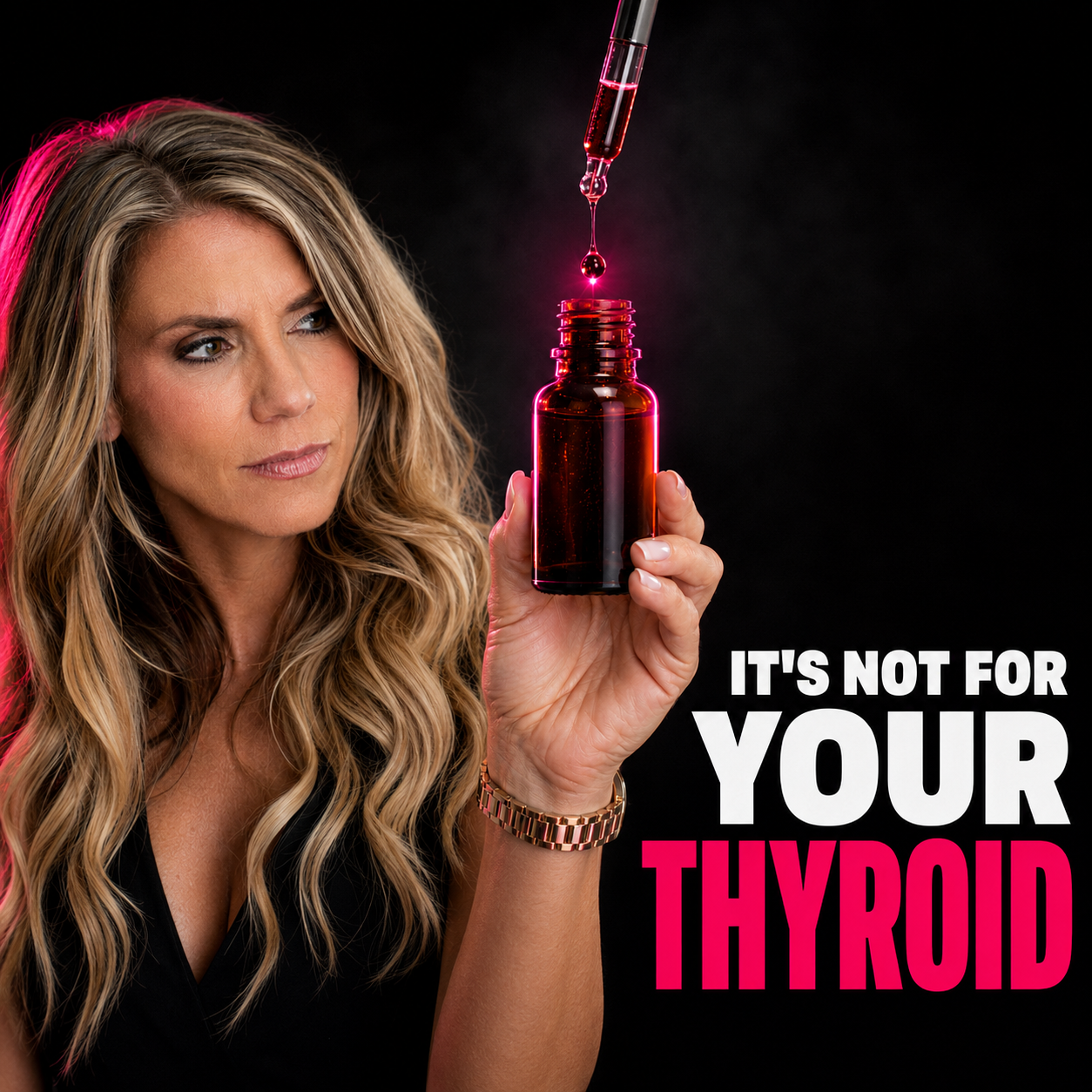

Iodine, Eczema, Histamine, Post-Surgery & Leg Swelling
Root Cause Report — The Health Revival Show
Result: NORMAL — protocol complete, no further action ✗ FLAGGED
You didn't fail the protocol — the protocol was run in the wrong order, at the wrong intensity, for the wrong duration. Kill phases last weeks. Rebuild phases last months. Nobody rebuilds.
Liz Roman (@thepoopqueen) and Becca Chilczenkowski (@thehormonequeen) answer five listener questions in this episode: iodine for cysts and fibroids, gut-driven eczema in an 11-year-old, histamine issues that survived every gut protocol, post-surgery constipation, and swelling around the knee that looks like lymphedema. Full transcript below.
Still stuck after doing everything right?
If you have run the protocols, spent the money and are still reacting to everything, the sequence was probably wrong — not you. A Root Cause Discovery Call is where we look at the actual order of operations for your case.
Frequently Asked Questions
Why do I still have histamine issues after doing SIBO, H. pylori and parasite protocols?
Most failed histamine cases were treated in the wrong order, at the wrong intensity, for the wrong duration. FitMom's practitioners find that a genuine SIBO, H. pylori and parasite picture needs roughly 16 to 20 weeks, with H. pylori cleared first so stomach acid can rebuild. Kill phases run weeks; rebuild phases run three to six months. Skip the rebuild and the infections come straight back.
Can iodine deficiency cause cysts, fibroids and thyroid nodules?
Yes. Iodine is a growth regulator, not just a thyroid mineral: it tells cells when to grow and, just as importantly, when to stop. FitMom's practitioners explain that when iodine is low that stop signal weakens, which is where breast cysts, ovarian cysts, thyroid nodules and fibroids come from. Iodine also shifts estrogen down the protective 2-OH pathway instead of the proliferative 16-OH pathway.
Can you have estrogen dominance with normal estrogen levels?
Yes. Estrogen dominance is about relative balance, not an absolute number. Becca Chilczenkowski explains that chronic stress depletes progesterone while xenoestrogen exposure adds estrogenic load, so growth signals get turned up and stop-growing signals get turned down even when estrogen tests normal. A DUTCH test showing high 16-OH metabolites is often more revealing than a total estrogen level.
Does topical iodine help fibrocystic breast tissue?
Topical iodine is used at FitMom when oral iodine alone does not resolve fibrocystic breast changes, meaning the lumpy, tender tissue many women notice before their period and through perimenopause. A drop of liquid iodine in a carrier oil or a breast care balm, applied lymphatically and alternated between sides, is the usual approach. Iodine stains, so use an old shirt or a flannel.
Why do I get a rash or redness when I start taking iodine?
A rash or redness around the thyroid after starting iodine is usually bromide and fluoride detox, not an allergy. Liz Roman explains that these halides compete for the same receptors and take up residence in tissue, which is why iodine can read low at a tissue level and normal in serum. Go low and slow, and pair iodine with selenium to protect the thyroid.
Where does brain fog come from when you have histamine intolerance?
Brain fog in histamine cases often traces back to the bacterial pattern itself. Liz Roman finds low Bifidobacterium alongside elevated Clostridia strains, which turn dietary amino acids into neurotoxic compounds that both worsen histamine and travel to the brain. The result is impaired cognition, memory problems and mood changes stacked on top of the histamine symptoms. An MRT test helps map what is driving it.
Is SIBO a root cause?
No. Liz Roman is direct about this: SIBO is not a root cause, H. pylori is not a root cause, and parasites are part of everyone's terrain. They are downstream findings. The real work is the terrain itself, meaning stomach acid, the mucosal lining, B vitamins, minerals, nervous system state and environment, which is why protocols aimed only at killing keep failing.
Can venous insufficiency be mistaken for a Baker's cyst?
Yes, frequently. Behind the knee sits one of the largest lymphatic junctions in the body, so venous insufficiency there produces localized swelling and fullness that gets mistaken for a Baker's cyst. Becca Chilczenkowski notes that a true Baker's cyst is a distinct palpable fluid-filled mass tied to knee joint pathology, and an ultrasound rules it out when swelling feels focal rather than diffuse.
How do you prevent constipation after surgery and anesthesia?
Get ahead of it before the surgery, not after. FitMom's practitioners use glutathione before and after anesthesia, magnesium citrate started pre-operatively, vitamin C, and high electrolytes at roughly a two-to-one potassium-to-sodium ratio. Choose basil seeds over chia seeds and MCT oil over olive oil, since MCT does not require bile. Anesthesia-driven constipation routinely lasts several days.
Full Episode Transcript
Listener Questions On Iodine, Eczema, Histamine And Leg Swelling
[0:00] Liz Roman: Welcome back to the Health Revival Show. We're diving into more of your questions because y'all have some really good questions, and we can't do it in, like, a Instagram story response all the time. So here we are. We're gonna dive in. First to … We had multiple questions around this topic, and I think it's a really great one because I know Becca and I have done a few different episodes on this. People need to understand the importance of iodine and the roles that it play in your body for growth. And so here were the questions. "Iodine for cysts, I heard it helps rid them. Is that a myth? And if so, what brand?
Iodine deficiency, is this related to fibroid growths? And what iodine do you recommend?" So let's start with the real root of all of this and understanding just how important iodine is.
Is Iodine Deficiency Linked To Cysts, Fibroids And Nodules?
[0:51] Liz Roman: Iodine is not only crucial for your thyroid, it's also crucial to help if estrogen is high regulate these growths. It plays a big role in pregnancy, too, and the growth and the development of the fetus. And many people don't know this, and they shy away from optimizing their iodine levels. When we look at the history of, you know, farming practices and how our soil has been depleted, farmers are not replenishing soil with iodine. They'll do it with other things, but not iodine.
And so unless you are somebody who's really particular about eating enough seafood and things that come, you know, from the sea, kelp, seaweed, those types of things, we are most likely insufficient in iodine. And there's a few ways that we can test this. I've done a reel about it, talking about, you know, iodine on the skin. Is that 100% accurate? No. But it's an at-home clinical clue that you can also look at other correlations, 'cause there's a lot of symptoms of iodine deficiency. You can also look at T4. If it's below a 7.5 total T4, I'm thinking potentially iodine deficiency. You can do serum iodine.
You can do urine iodine. Like, there's other ways to test this, but those can be cost-prohibitive. And so I think this is just really important to recognize that- Almost nobody is really, really sufficient with iodine unless they're doing a great job being intentional with their diet, and this matters. Again, I said it's a growth regulator. It's not just for your thyroid. It helps your cells know when to grow, and just as important, when to stop. So when you don't have enough of it, the stop signal gets weaker, and that's where the cysts come from. That could be nodules. It can be fibroids.
It can be cyst in the breast or cyst in the ovaries. So there can be different types of growth that has gone unregulated. So first, let's dive into the estrogen connection because we commonly see this, and it's not talked about enough.
How Does Iodine Change The Way Your Body Breaks Down Estrogen?
[2:53] Becca Chilczenkowski: Yeah, so iodine helps balance the body out when it comes to estrogen because your body breaks estrogen down into different metabolites. We have talked about this quite a bit. The Dutch test will test this in terms of the 2-hydroxy- The 4-hydroxy and the 16-hydroxy. And so there are basically different versions, and some of these versions are more protective, including the 2-OH, others are more proliferative. The 16-OH is actually what seems to be the most proliferative when it comes to growth of tissue. The 4-OH is a little bit more concerning when it comes to, like, cancer potential.
And so iodine helps shift the balance towards the protective pathway. And when iodine is low, estrogen is already dominant in a lot of cases, very common with everything that we're exposed to in terms of xenoestrogens and chronic stress depleting progesterone, and hormones are all about relative balance. And so you don't have to have high estrogen to have estrogen dominance. But the growth signals end up essentially getting turned up and the stop growing signal turned down.
And so it's the exact combo that we see with cystic breast tissue, thyroid tissue, ovarian tissue, all of it is iodine responsive, and at a tissue level. And so this is unfortunately where taking oral iodine for some people is not the full solution. They need to obviously fix underlying what's going on with the estrogen dominance. They need to fix their detoxification capacity. But sometimes we do bring in topical iodine, for breast tissue specifically. So tissue by tissue, breast tissue is probably the strongest when it comes to research.
Fibrocystic breast changes like lumpy, tender, kind of that cystic tissue a lot of women will deal with before their period especially. But we also see it during perimenopause because of the hormonal shifts that go on. So these are all linked to low iodine. In clinical trials, we see this, and women using iodine saw improvement in pain and cyst size.
Does Topical Iodine Help Fibrocystic Breast Tissue?
[4:44] Becca Chilczenkowski: When oral iodine is not effective, we will sometimes bring in a topical iodine option, which is basically just using iodine liquid, a drop of it, and you can put it in a carrier oil or a carrier balm. I like using-- There is a balm that is an anti-inflammatory breast tissue balm,
[5:03] Liz Roman: Like this one
[5:04] Becca Chilczenkowski: In here, and so I'm not gonna butcher it. It is called Banyan. It is on Amazon even. I believe it's even in Fullscript. But it's a breast care balm, so you can use it lymphatically on the breast tissue. I actually just posted about this in terms of like a kind of recipe for it. But iodine does stain. So if you are using this topically, you want to use like, you know- Either an old shirt that you wear at night when you do it before bed, or you can use a flannel, or you can use kind of that castor oil style pack. But you do wanna be careful because it can stain.
And you don't need a ton of it, and you can alternate breasts, or if there's a specific spot that's very dense or cystic, that's where you can use it on. So the breast tissue piece is very real.
I see it often with people when they start estrogen hormone replacement therapy because they go from having very little estrogen circulating in the body to now a lot of estrogen, and if they are also metabolically unhealthy or they are inflamed or there's other things going on, it kind of triggers this, "Okay, now the body's overloaded essentially with we're having to process and detoxify this new large amount of hormone," and it struggles.
[6:14] Liz Roman: Yeah.
Why Do I Get A Rash Or Redness When I Start Taking Iodine?
[6:15] Liz Roman: We even talked with, I'm forgetting her n- last name, but I remember it was Dr. Sarah, and we were talking about when you are adding iodine in, if you start to get symptoms like rashes or redness, specifically around your thyroid, this can be because you're actually starting to detox bro- bromide and fluoride. And so just knowing that these different things in our environment compete with iodine receptors, and so they can take residence there, and that can also be why you're low at a tissue level but high maybe in serum, right? So I think it's just there's a lot to look at.
But in terms of the thyroid, this can be very, very helpful. We use this a lot in many of our cases. So Iodoral, we use that. There's a 6.5 or 6.25 milligram and then also a 12.5 milligram capsule that you might do a few days a week. You might use Detoxadine. That's the one that I showed for the skin test, and then again, that would be one that you could use topically. And there is a great article that Dr. Jockers wrote on this as well. But I would just be cautious if you have known autoimmunity. You would definitely wanna be careful, go low and slow, and then pair it with selenium.
Selenium can be, very helpful just to protect your thyroid while iodine helps, improve function and do its job.
Does Iodine Help Ovarian Cysts And PCOS?
[7:39] Liz Roman: Within the ovaries, the research here is a bit thinner. So most ovarian cysts are hormonally driven. They are tied to ovulation or something, maybe like a, PMOS or PCOS is used to be what it names. So the bigger level for ovarian cysts is usually blood sugar and insulin, not iodine directly. But again, iodine is a growth regulator. So we have to ask the question, what's going on? And we've another podcast on this with the trifecta of iodine, estrogen, and iron as well. So we wanna balance out that estrogen and again, make sure that we are clearing it. So we always say low and slow.
We want to, you know, recognize this can be an incredible tool for various cases and chronic cases, but we need to respect how powerful it is and be wise with using it with dosing, monitoring symptoms, measuring your thyroid if you're using it for your thyroid, and then again, considering other things here as well, such as, you know, your detox pathways like Becca mentioned, and then selenium
What Can I Do For My Child's Eczema Through Gut Health?
[8:38] Liz Roman: Use too Question number two, what can I do for the gut health of an 11-year-old to improve his eczema symptoms? So number one, I would look at the foundations. What does your diet look like? 11-year-olds can be challenging. And so I would say if you can, work towards eliminating sugar, dairy, and gluten as a start. This can be really hard. So, you know, do some swaps at home. You can go rip the Band-Aid off if they're up for that, or you can go slow and choose one thing to start removing, and then walk in more of the good. So more antioxidants.
I would say more pre- and probiotic-rich foods if that's tolerated, fermented foods. Those are gonna be things like kefir, kimchi, sauerkraut, pickles, you know, some of those really good probiotic-rich foods that can seed the gut. But we need prebiotics with that as well. So I love, if it's by you, you can find Orante's yogurt. It's an A2/A2, and it's generally easier tolerated, but it's got chicory root fiber in there. It's one of the best prebiotics to feed probiotics. So if you can't get that, look at what you are consuming and see, like, is there a prebiotic feeding the probiotics?
Otherwise, if there's not, you're just-- that is not doing you any good. You're basically not feeding the bacteria, so it's dead before it ever gets to your gut, and it's not gonna survive. The second thing that I would be thinking about is, you know, of course, we can't go without doing a podcast and saying that, number one, with that, you should be testing. You should be checking your environment for mold mycotoxins. You should be looking at environmental toxins and things that are in your different chemicals, your laundry detergent, the things that they're using on their body every single day.
You also would wanna think about your water quality and make sure that you have clean, filtered water. If you don't, all the chlorine, chloramines, all the nasty stuff that's in tap water is gonna be irritating, too. Eczema's like an open wound, right? The barrier is broken down. So we have to support the internal barrier absolutely with anti-inflammatory supports, support the gut lining, get our diet right, antioxidants in place, but we have to make sure that we are considering all of the external irritants as well. So testing would be great.
I would love to see, if, you know, finances weren't an option here, a mold mycotoxin test in environmental toxins as well as a stool test. Stool test would be my number one, but a mold mycotoxin, environmental toxin, and heavy metal test would be with that if it's, you know, you're able to do that. And then I just didn't wanna say, you know, this conversation without calling out chronic skin issues have been linked to all-cause mortality. There's a long-standing study that's still going that basically says when your skin barrier is broken, you have a higher mortality rate.
So again, this person is-- this child's 11. I don't know him or her. I think it's a, a he. Not to be doom and gloom, but this is overactive immune. Okay? So the immune system is attacking the skin. A lot of this comes within. So we talk about Oliveida a lot. If this is olive oil, if it's an internal, like IO1, camu camu, high in antioxidants, vitamin C. If you can make a vitamin C spray, I have that on my Poop Queen Instagram. It's super simple. You literally buy from Amazon. It's less than, I don't know, I think $10 for, sodium ascorbate. That's gonna be gentler.
You put a teaspoon of that with some distilled water, and you spray it all over before you're going into pools or lakes or whatever, just anything that's gonna have chlorine. That can help. But I would say here, think about other things that can help calm the immune system down. I would avoid hot therapy at all costs, so not doing hot showers, no hot tubs. I would do more of the cold and, you know, you could do maybe lukewarm, but I would really try to just get more on the cold shower side. Breathwork, this can be very helpful to kinda shifting, the nervous system into, like, more of a calm state.
And then again, you've just got to think about all of the other foundational things. Has there been a trigger? Was this related to some change that you made in your home? Was it related to an infection, a vaccine? There's just so many questions to ask, and eczema is very multifaceted and complex. But I think you can start at minimum with the diet and some of those lifestyle behavioral things and adding more of the good in, but of course, I would be wanting to test if it was my child. I'm doing a stool test, and I'm doing a total tox test.
[13:13] Becca Chilczenkowski: Yeah, and then wasn't there SIV was the topical-
[13:18] Liz Roman: SIV can be great, yeah.
[13:19] Becca Chilczenkowski: Yeah.
[13:19] Liz Roman: Mm-hmm,
[13:19] Becca Chilczenkowski: SIV. I was thinking about that, too, which is kind of like a microbiome balancing serum. It's intended for things like eczema and to help with when we know that there's probably a skin barrier that's been broken, and it's now affecting the immune system as well, which Liz just obviously talked about. So that is another one that came to mind 'cause I know that that's one that we will sometimes recommend with
[13:41] Liz Roman: Eczema. SIV.
[13:42] Becca Chilczenkowski: Yep, SIV.
Why Do I Still Have Histamine Issues After SIBO, H. Pylori And Parasite Protocols?
[13:44] Becca Chilczenkowski: Next question, histamine issues with almost everything. I did a SIBO protocol, H. Pylori, and a parasite protocol. No help Obviously, there's so much that could have been done with in SIBO, H. Pylori, and parasite protocols. I evaluate, like, one, how long was the protocol and how intensive was it? I think a lot of times people try to just use one or two products and hope that because symptoms have subsided a little bit, things are resolved, which is rarely the case. In … If this is truly, like, a SIBO case, parasites were detected, there was H.
Pylori, that protocol altogether is probably gonna be close to 16 to 20 weeks. And there's going to be, in that time period, a lot of diet variation and probably a decent amount of fasting done to help suppress the immune system to an extent and kind of reset it. And we see this in a lot of research, MCAS cases in particular, their calmest days are typically fasting days, and that's not for no reason. It's kind of a pretty clear diagnostic clue that that total food and antigenic load will continue to irritate things.
And what we know is that these, you know, T cells have about a three-month memory, and so you have to keep things calmed down for that duration of time. You can't just keep eating things that are causing immune flares or, you know, not doing what you're supposed to be doing, which is why healing's so hard.
Like, there's a lot of restriction in the actual healing phase that we ask of our clients, and I'm not saying you can't have any slip-ups ever, but, like, there's a really real thing, if you're trying to just do a GI protocol for three, you know, even, like, six to eight weeks, you're probably not addressing everything if you're dealing with all this. And it wasn't done in the right order, right? We need to address, make sure that H. Pylori is typically addressed first so that we can get to stomach acid and ensure that stomach acid is starting to be rebuilt.
And then on the back end, a lot of kill phases, you know, weeks. Rebuilding phases are, like, months, if not longer. We're talking, like, three to six-plus months when we're trying to rebuild things. And so on the back end of all of this eradication probably, was there rebuilding of the mucosal lining? Was there support with the immune function of the gut? Was there support with butyrate and short-chain fatty acids? Like, what all was done? Because we also know that there's a lot of probiotics that can actually worsen histamine. Did they try to repopulate with some of these?
There's so much that's usually missed, and in these reoccurring cases, does not ever get addressed, which is why they continue to be reoccurring. And so I would say from the you've done all of this stuff and are still struggling side of it, my guess is there probably wasn't the right things done with the right intensity in the right order. The other piece that I think of is emotional and, and trauma, because a lot of times this is skipped because it's hard and it's hard to object- objectively evaluate and measure. But we're talking, like- emotional release therapy.
We're talking, you know, tapping, like talking to a therapist, potentially doing EM- EMDR. EDMR? I always get the acronym mixed up. Yeah. Yeah. Emotional. Yeah. And so, you know, the, the nervous system becomes so hypervigilant in these states that it can be really hard to even get to anything without addressing that piece. You have to get the body into a parasympathetic state. So a lot of times we'll use things like the Pulsetto. We'll use things like m- EMF mats, like these things that help to pull the body into that state knowingly because sometimes deep breathing's not enough.
Sometimes, you know, even going to therapy, like you need to basically fix the frequency of the body because it is so stuck.
Can Mold And A Dysregulated Nervous System Stop Gut Healing?
[17:41] Becca Chilczenkowski: So that's another piece, and then the last piece I would say is environment. Like are you living in mold? Are you potentially being exposed to something daily that's keeping you stuck? There's so much that has to be evaluated and has to be diligently a- addressed. Like the, it … You can't just go through some different protocols and hope that this is resolved. When the body gets to this place, which I actually heard a statistic this morning around about 20% to 30% of the population is suspected to have MCAS, which is crazy. It's a large amount of the population.
[18:10] Liz Roman: Is that since, 2020?
[18:12] Becca Chilczenkowski: I don't know about the date, but it would make sense with, with the ha- his- history of COVID. But the nervous system piece is so big because the vagus, the vagus nerve regulates the gut barrier integrity and the mucosal production directly, right? And motility, which then is going to affect SIBO upstream and all of these other GI imbalances that occur. So yeah, I think that there was probably stuff that wasn't fixed and addressed that should have been maybe in the right duration and the right intensity, because it's definitely one of the harder cases to manage.
Why Does Killing Pathogens Never Fix The Gut On Its Own?
[18:48] Liz Roman: Yeah. And I think too, just looking at this, right, so if we think about digestion being a north to south process, people will go in and they'll do all of the eradication and the killers, but they won't support their stomach acid, which allows all of these pathogens to take residence. And if they don't tolerate HCL, they don't go back to it because they just write it off as, oh, they didn't tolerate it. It is one of the utmost important things in every single gut healing protocol that needs to be addressed is inadequate stomach acid levels and doing the appropriate titration to see what you need.
But I couldn't agree more. I think there's way too many people doing kill, kill, kill, and not enough of rebuilding. In this case, if it were me, I would solely go in with supports. Digestive supports, build your microbiome up, put in a lot of those good histamine-friendly probiotics.
Where Does Brain Fog Come From When You Have Histamine Issues?
[19:40] Liz Roman: The Gut Institute has a really good probiotic that's histamine-friendly that we're gonna be adding into several of our cases because a lot of times when I see this picture, we are very low in the bifido family, and we are seeing that there are Clostridia strains that are higher, and what happens with that is when you consume proteins, that starts to turn some of these amino acids into neurotoxic compounds that further exacerbate histamine. But they go to the brain, and they start to impair your cognition and your thinking and your mood.
And so now we see that we have brain fog and memory issues, and that on top of the histamine issues, you know, is not a great quality of life. And so you have to have a lot of considerations about what's happening chemically. This is where an MRT test would also be very valuable, not only going to a low-histamine diet, but a diet that if you can see on testing your neurotransmitters how they're behaving, what all these different amino acids are doing, things like vitamin B2, vitamin B6, some of these are co-factors for the conversion of neurotransmitters and amino acids into different acids in the body.
So I think there's been a lot that was probably done right, but a lot that maybe was overlooked in the case of how are we going to address why this was all happening, because SIBO is not a root cause. H. Pylori is not a root cause. Parasites are part of everyone. So it's really about the terrain and taking that terrain-based approach, cross-referencing with all of those B vitamins and different minerals and things that are really important to get the body back in line to function the way that it should.
But if we're consistently, like Becca was saying, stuck in that sympathetic dominant state and stressed, that is a negative feedback loop to further depleting those vitamins and minerals We didn't even touch on magnesium and all the other things, vitamin C, right? Yeah. That we know can be
[21:37] Becca Chilczenkowski: Vastly…
[21:38] Liz Roman: So it's just a complex thing there.
How Do You Prevent Constipation After Surgery And Anesthesia?
[21:42] Liz Roman: Okay, next question. Help with post-surgery constipation anesthesia. Easy-peasy. I would be doing glutathione in and out of, anesthesia, so before and after, supporting with magnesium, vitamin C. I would also think about your diet and what we could do here. Could we add in some very healing, soothing foods? We love a bit of fasting, depending upon, you know, what the case was, why you had anesthesia, if it was a surgery or whatnot. A bit of fasting, but if not, you know, then think about high electrolytes.
So bone broth can be very, nourishing if you don't have histamine issues, soft foods, smoothies that are really punched with, or packed with a punch of antioxidants. You can put oils in there, seeds, all kinds of things, higher hydration to flood the system. And then here's where I would probably go more towards, like, a two-to-one potassium to sodium ratio, maybe a three-to-one. I don't know your case, your blood pressure, all that kind of stuff, but definitely a one-to-one potassium to sodium ratio.
[22:42] Becca Chilczenkowski: Yep. Absolutely. I find that I try to get ahead of it, too. So I've had many surgeries, couple of different births. And when you especially have a surgery where, like, you don't wanna strain your stomach or maybe after birth you don't want to re-tear anything, I was, like, on high dose of citrate prior to the surgery even, and then post-surgery to keep things moving. 'cause absolutely s- anesthesia effects will last days, in terms of the constipation piece, so it's awful. Awful.
[23:17] Liz Roman: Do, use a stool, stool softener, too. Sure. Oh, yeah. Like, these are the cases where it's like you don't have- Totally … shy away from everything. Like, Becca and I have both talked about this, in terms of the first poop after pregnancy being, like, the wor- You're so nervous. Yeah. You're like, "I hope this doesn't tear apart 'cause I've already had so much trauma." So just use anything and everything to soften things, and stay away from chia seeds.
I would go with basil seeds absolutely in this case, like, if you're doing smoothies, and I'd go probably more MCT oil over olive oil, just because that doesn't require bile. Give your body and digestive system a bit of a break on the liver front, too, 'cause the liver's processing all of that.
[23:57] Becca Chilczenkowski: Yeah. I, tummy tuck post, post-tummy tuck poop was probably the most terrifying 'cause you, like, cannot squeeze yourself.
[24:03] Liz Roman: Yeah.
[24:04] Becca Chilczenkowski: Yeah, it was awful. Okay.
[24:07] Liz Roman: Yeah, with tummy tucks, right? And so
[24:08] Becca Chilczenkowski: That's- Yep. Yep … C-section. Yep.
[24:10] Liz Roman: You have, yeah, more vaginal. So I don't… There's no right way. Yeah. Let's just be thankful we're past the state of postpartum.
Can Venous Insufficiency Look Like Lymphedema Or A Baker's Cyst?
[24:16] Becca Chilczenkowski: Okay. Last question. "Can venous insufficiency look like inflammation or lymphedema around the knee area? Thoughts?" So let's define first what chronic venous insufficiency is. So it happens when one-way valves in the leg veins basically stop closing properly, and so blood refluxes backward and pools instead of returning to the heart efficiently. So that backward pressure, which they call venous hypertension, pushes fluid out of the capillaries into the surrounding tissue, and that's the edema piece that happens with this.
So people call… It's pitting essentially, but you get… You know, you can put your finger into your leg and it doesn't retract easily. It, it basically stays indented. But it's… The problem is it's not just fluid. So it triggers basically this very real inflammatory cascade in the tissue, and leukocytes get trapped and activated in the microcirculation. Inflammatory cytokines or AKA inflammatory messengers and what they call matrix metalloproteinases get released.
So CVI doesn't just look inflamed, it generally is very locally inflamed, and it's the underlying mechanism behind what's called stasis dermatitis or kind of this, like, red, scaly, itchy skin you see with longstanding venous disease. And I see this a lot of pe- times with people that become very sedentary and do not properly al- allow circulation to happen, and the knee area is meaningfully a junction point anatomically speaking.
So this small saphenous vein terminates into the po… I'm… This is getting way too scientific for everyone, but basically this vein around the knee exits into a different vein right behind the knee, and that's where lymph nodes sit. So if you know, there are big sixes of, all around the body, of big lymphatic highways. Behind the knees is one of the biggest lymphatic highways. And so localized to that area, it'll produce swelling, it'll produce fullness, it'll produce this, like, localized inflammation that often actually gets mistaken for a Baker's cyst.
So people think that they have a Baker's cyst going on, when in reality they actually have localized inflammation from this venous insufficiency. And it, it turns into chronic. It's not something that automatically is like if you have venous insufficiency it is chronic venous. No. This is like early stages and They are not necessarily separate diagnoses. So like the lymphedema and the CVI or the chronic venous insufficiency can often come together, which is crazy.
So it, you know, progresses essentially into this big lymphatic picture, which is considered one of the most common forms of lymphedema, and it's commonly under- under-recognized because the presentation often overlaps between the two So it's-
[27:11] Liz Roman: Very interesting
[27:12] Becca Chilczenkowski: Venous insufficiency is crazy. I've seen it in young people too. I've seen it in a lot of, like, 30-year-olds, that have a lot of other immune issues going on and, you know, poor lymphatic flow, and genetically some lymphatic issues, which I also see with lipedema. There is absolutely a genetic piece to a lot of this. And I think that a big piece of it is hormonally driven.
People that struggle to detoxify estrogen well, that aromatize at really high rates, that also have maybe inflammatory-based genetic mutations, I think it can become kind of this, like, perfect storm, 'cause we see lipedema actually develop at puberty, in a lot of cases. So like, at that point, y- yes, you can have metabolic dysfunction.
Of course you can as a child, but in a lot of these cases it's more so, like, they're kind of predisposed to these things, and then combined with maybe environmental exposures or GI imbalances or whatever might be going on, it kind of manifests into this, and then it worsens as you, you know, go through life. And then around perimenopause is another big time obviously. But yeah,
[28:17] Liz Roman: It's crazy. So interesting, and I think too, I've seen it more, like, with pregnancy and as people are getting older in those perimenopause years where especially, like, spider veins and just blood flow in general, right? Vascular integrity. So we wanna support that nitric oxide production, all of that.
So let's kind of break this down to distinguish what might be driving it if you're kind of thinking, "Okay, well, which one might be me?" So venous insufficiency, worse at the end of the day, better after elevation or overnight, so this als- often has visible varicosities, or staining, so brownish discoloration from old blood breakdown and tends to spare the foot and the toes. Lymphedema tends to involve the foot and toes specifically. It's a positive Stemmer's sign. Can't pinch a fold of skin at the base of the second toe is a classic distinguishing feature of lymphedema.
It's also le- less likely to fully resolve overnight once it's progressed. The Baker's cyst, distinct palpable fluid-filled mass, specifically behind the knee, as Beck talked about, usually tied with underlying knee joint pathology, so osteoarthritis, a meniscal tear, those types of things, and so you would maybe wanna rule this out with an ultrasound if the swelling feels more focal mass-like than diffuse.
Why Do My Legs Swell More In Pregnancy And Perimenopause?
[29:29] Liz Roman: And then venous walls have estrogen and progesterone receptors. So again, like you mentioned, those hormonal shifts genuinely affect the tone and valve competency. Progesterone in particular relaxes the smooth muscles, which is part of why vascul- varicosities and venous symptoms often worsen in pregnancy and can fluctuate across the cycle, or again, through menopause.
How Does Nitric Oxide Affect Circulation And Leg Swelling?
[29:54] Liz Roman: So and I'm just gonna bring this back to nitric oxide, 'cause we see this a lot. When estrogen is low and nitric oxide is low, we're not getting that circulation. Of course, we can put in different things to help circulation, but I would be checking simple at home. You know, obviously we talked about, like, the pitting and different things like that, but if you alternated your Electrolytes. What does that do to water retention and pooling in the legs and things like that?
If you started working on your lymphatic system with Big Six, EFA tapping, putting legs up the wall, vibration plates, you can just vibrate yourself. Did you know that? It … I used to be a hip hop dancer, so we vibrated all the time. Like, you don't have to buy those expensive plates to do that, but you need to get moving and rebounding and do different things. There's actually the Tulum Trainer, go give her a follow. Shout out to her. I've been doing some of the things that Stephanie brought into our Clinical Pearl around this, and it's kind of fun. And it's like, "Oh, okay, I see why.
This just kinda gets you loosey-goosey and improves your mood." So the, the Tulum Trainer has a lot of these different movements, and I think mobility is often overlooked. Again, yes, there can be the genetic component, the hormonal component, you wanna support all of that, but I think people are lacking some of these different movement modalities because they're not getting into the ranges of motion that can help really also elongate things and keep your body moving fluids through. So try all of that, and then maybe I would say too cold showers and check your nitric oxide. Get Amazon less than 10 bucks.
Humanin is the brand that we like. They're the same brand that has the Neo40 tabs. My nitric oxide went up within about a week of taking those, and I also saw on my bristle stool Bristle stool, dang it. Bristle oral microbiome test that my nitric oxide was really low. I was at .6 out of 10. I had another one come back for a client in menopause hers was .1 out of 10. We're like, "Well, we're just gonna go off of Neo40." But Raynaud's, it's been so helpful for … Okay, so I have a client that has Raynaud's. She had a vein issue, and she actually had stents put in and all this kind of stuff.
Neo40's been very helpful. So that, and it's why I'm bringing it up, it could be something to look into.
[32:16] Becca Chilczenkowski: Absolutely. Circulation is a multifaceted thing. There's so many aspects that you wanna consider, and I've talked to a lot of people that, like, yes, they do lymphatic drainage, they do hydration, they do these things, but it's an inflammatory condition, right? And so what is driving the inflammation? What is … You can do exercise, you can do all of these things, but you have to get to the root issue of why we're still having problems, right? And in particular I see lipid may be one of those main ones, and venous insufficiency tends to be a little bit more late onset, after accumulation of things has happened.
So for sure get ahead of it. Movement is, is medicine. I, 100% I think that once you stop moving, disease starts creeping out a lot faster. So keep your, keep your body moving as long as you can. I plan to be 85 and working out still and lifting weights. Um-
[33:09] Liz Roman: We can go farther than that. My dad's 90. Come on, he's still driving. I mean, he's doing bumper cars, but he's still driving, so, and he's still going to the gym every day and swimming. We can be older than 85
[33:18] Becca Chilczenkowski: Well, I plan to be, but I just gave that as a gauge of like I plan to be this old and still holding some good muscle tissue with the help of HRT. So keep submitting your questions, guys. We love answering what you wanna know. And we will see you on the next one.
Key Terms From This Episode
Iodine — A trace mineral that regulates cell growth. It is required for thyroid hormone production and also tells breast, ovarian and thyroid tissue when to stop proliferating.
Growth regulator — A signal that controls both when cells grow and when they stop. When the stop signal weakens, unregulated growth shows up as cysts, nodules or fibroids.
2-OH / 4-OH / 16-OH estrogen metabolites — The three pathways estrogen breaks down through. 2-OH is protective, 16-OH is the most proliferative for tissue growth, and 4-OH carries the most cancer-related concern.
DUTCH test — A dried urine hormone panel that measures which estrogen metabolite pathways the body is favouring, rather than a single total estrogen number.
Estrogen dominance — A relative imbalance where estrogen's growth signalling outweighs progesterone. It can occur at normal or even low absolute estrogen levels.
Fibrocystic breast changes — Lumpy, tender, cystic breast tissue that typically flares before the period and through perimenopause. Strongly iodine responsive in the research.
Bromide and fluoride competition — Environmental halides that occupy iodine receptors in tissue. Detoxing them when iodine is introduced can cause rash or redness around the thyroid.
Selenium — A mineral paired with iodine to protect thyroid tissue while iodine restores function. Especially important with known autoimmunity.
MCAS (Mast Cell Activation Syndrome) — An immune condition where mast cells release inflammatory mediators inappropriately, driving histamine symptoms across multiple systems.
SIBO — Small Intestinal Bacterial Overgrowth. A downstream finding, not a root cause, usually driven by low stomach acid, poor motility and nervous system dysregulation.
H. pylori — A stomach bacterium that suppresses stomach acid. It is addressed first in a gut protocol so acid production can be rebuilt.
Bifidobacterium — A protective bacterial family that is commonly depleted in histamine-driven gut cases.
Clostridia — A bacterial group that, when elevated, converts dietary amino acids into neurotoxic compounds that worsen histamine and impair cognition.
MRT test — Mediator Release Testing. Used to identify food and chemical triggers of immune-mediated inflammatory responses.
Chronic venous insufficiency (CVI) — A condition where one-way valves in the leg veins stop closing, so blood pools and pressure pushes fluid into surrounding tissue.
Venous hypertension — The backward pressure inside leg veins that drives the fluid leak and inflammatory cascade seen in venous insufficiency.
Stasis dermatitis — Red, scaly, itchy skin caused by the local inflammation of longstanding venous disease.
Stemmer's sign — A diagnostic check for lymphedema. If you cannot pinch a fold of skin at the base of the second toe, the sign is positive.
Baker's cyst — A distinct fluid-filled mass behind the knee, usually tied to knee joint pathology such as osteoarthritis or a meniscal tear.
Nitric oxide — A molecule that drives vasodilation and circulation. Production falls when estrogen falls, contributing to pooling and swelling in the legs.
Vagus nerve — The nerve that directly regulates gut barrier integrity, mucosal production and motility. Dysregulation here blocks gut healing upstream.
Sources And Tools Mentioned
- Dr. David Jockers — article on iodine
- Iodoral (6.25–12.5 mg oral iodine)
- Detoxadine (nascent iodine, oral and topical)
- Banyan Botanicals breast care balm
- SIV microbiome balancing serum
- The Gut Institute — histamine-friendly probiotic
- Bristle oral microbiome test (nitric oxide)
- HumanN Neo40 nitric oxide support
- Oliveda IO1 internal olive oil
- The Tulum Trainer — mobility and lymphatic movement
Still stuck after doing everything right?
Liz and Becca are licensed functional health practitioners running real root-cause lab testing — stool, DUTCH, mold, environmental toxins and metals. If you want your case looked at properly instead of guessed at, start here.