

Chronic Pain, Brain Fog, IBS — One Cause Nobody Tests
NORMAL
↳ measuring the wrong compartment
A calcium shell is not a diagnosis — it's a pattern seen on an HTMA (hair tissue mineral analysis) test, where calcium leaves the bones and teeth and accumulates in soft tissue instead: joints, muscles, fascia, nerves, and the brain. FitMom's practitioners find it drives chronic pain, stiffness, IBS, brain fog, kidney stones, and anxiety. Standard blood calcium usually reads normal — or even low — while it's happening, which is why it is routinely missed.
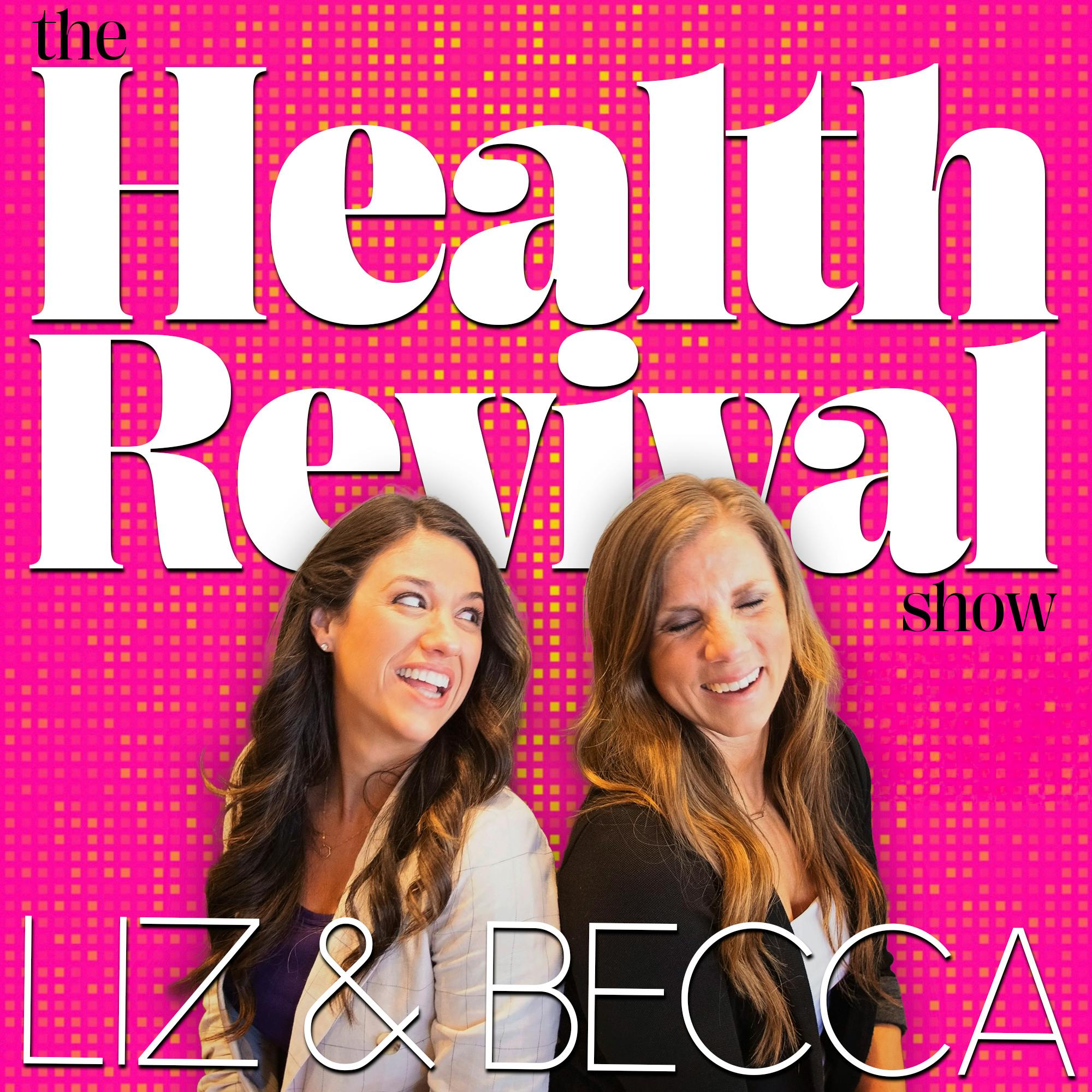
The Health Revival Show · July 14, 2026 · 20 min
With Liz Roman (@thepoopqueen) and Becca Chilczenkowski (@thehormonequeen) — functional health practitioners at FitMom.
In this episode
03:03 Why hot flashes are not just a low-estrogen problem
05:34 The neurotransmitter link most hormone protocols ignore
06:38 What a calcium shell actually is
07:44 The symptom list: pain, stiffness, IBS, brain fog, kidney stones
08:11 Why calcium leaches out of the bones in the first place
09:02 Why mineral balancing on its own can make you worse
11:00 Mold detox: the order of operations most protocols get backwards
12:16 Probiotics, die-off, and the binder ladder
14:34 How to survive a moldy environment you can't leave
Why hot flashes are not just a low-estrogen problem
03:03
LIZ: Today with the Q&A, we're going to cover three questions for you. LDMiller2 asked: "What is the best supplement for hot flashes? Totally kills mood at night for intimacy."
Obviously there's a lot that can be done if you've optimized things and you're ready to go on hormones — progesterone could be nice to balance this. But even then, it's not always the right answer, or you're not ready to go on HRT. So what I'd recommend is Life Extension Menopause Relief. It's very affordable, I find it very effective, and it's a specific type of rhubarb that can work really well. Most of the time it's dosed one capsule at nighttime. You can do a capsule in the morning if you're noticing you're starting to get hot flashes.
You could also do other things. Make sure your environment is cool. Maybe take a cold shower before bed. Essentially, when estrogen is fluctuating and swinging around, we start to get these hot flashes that are very uncomfortable. I haven't experienced them yet, and I'm not looking forward to it — but with my mattress, I bought every upgrade possible for the cooling technology, and I have my Cozy Earth cooling sheets, which I'm a snob about and I'm never giving up.
BECCA: You could even start with something like Progon B, Estrovera, Femestro Plax. A lot of those are options.
Sometimes, believe it or not, just lowering inflammation helps. I'm not saying go on a GLP-1 — but the reason GLP-1s work for a lot of these things is that in general they lower inflammation, which limits how sensitive you are to thermal regulation changes.
So I think a lot of times night sweats and hot flashes are not just low estrogen. I think there are other dysfunctions going on. A cold shower at night can be really helpful, making sure the room is cold, wearing more breathable clothes, breathable sheets — all of those things help.
But I'd be looking at other things. Why are we having these? Are you truly low in hormones? How long have they been going on? I've experienced them most when postpartum — you're just sweating out pounds of weight that you had gained. And I experienced them when I was struggling with my cycle. I'd get them right before my cycle, when estrogen was dropping and it was not clearing very well, and it was not being balanced by progesterone.
So again — not just a low estrogen problem.
The neurotransmitter link most hormone protocols ignore
05:34
LIZ: There's a really good article by Dr. Liz Bartman, who we like a lot. She talks about the involvement of neurotransmitters — norepinephrine being increased, and how that can contribute to instability in regulating body temperature. Serotonin too.
So again, we may want to look — just like we do in all cases — at what's going on with your gut microbiome. We can always start with blood work and see what's going on there. But some of the stool testing we run now has neurotransmitters added, which is a really cool thing we can see, because these could be other contributing factors beyond just altering estrogen levels.
What a calcium shell actually is
06:38
BECCA: The next question is around a calcium shell.
Let's talk about what a calcium shell is, because it's not a diagnosis. It's a pattern from a test called an HTMA — a hair tissue mineral analysis test. It's essentially what happens when calcium builds up in your soft tissues — your joints, your muscles, your brain, your nerves, your fascia — instead of your bones and your teeth, where calcium should remain.
The result ends up being chronic pain, muscle stiffness (think fibromyalgia), constipation, IBS, brain fog, depression, anxiety, osteopenia, kidney stones, poor dental health.
And doctors often miss this because blood calcium looks normal — even low, honestly, a lot of the time — when calcium is silently building up in your tissues like concrete in your fascia.
Your body cannot move smoothly anymore, because your fascia are these webs of tissue that support the muscles.
Becca Chilczenkowski
That's why HTMA can be really helpful in this case.
The symptom list: pain, stiffness, IBS, brain fog, kidney stones
07:44
BECCA: If you have symptoms like:
- Chronic pain or fibromyalgia
- Bloating, cramping, slow digestion
- Joint pain or stiffness
- Constipation or IBS
- Osteopenia or osteoporosis
- Brain fog or emotional numbness
- Anxiety or depression
- Kidney stones — that's a big one. Again, that buildup.
- Low motivation, apathy, or insomnia
A lot of things can point back to calcium being in the wrong place.
Why calcium leaches out of the bones in the first place
08:11
BECCA: So why does this happen? This doesn't just occur. It's typically a result of:
- Low stomach acid — which makes you unable to absorb calcium.
- Gut pathogens — H. pylori and C. diff are both big ones, because they mess with mineral absorption and can create pain.
- Copper toxicity — which drives calcium to harden in tissues.
- Mold and toxins — which drive chronic inflammation.
- EMFs — which can disrupt your calcium channels.
- Thyroid issues or low iodine — low iodine is an epidemic lately. We see so many issues with it.
- Emotional trauma or long-term stress — because your body basically armors up. It does things to cope that you may not even be realizing.
Calcium is leaching out of where it should be — the bones and the teeth — and getting into the tissue, and it clogs things up. Think of how cement starts as this thick consistency and then hardens. The same thing can be happening with the calcium.
Why mineral balancing on its own can make you worse
09:02
BECCA: So how can we reverse it?
Most medical advice will say to take calcium or magnesium, which isn't necessarily the best way to do it. It's a bit of a Band-Aid.
We'd be running a GI Map. I'd be running an MRT. I'd potentially be running an HTMA, obviously. But you have to identify why. What is the root issue of what's going on?
Then there are specific mineral balances you can create based on the HTMA to slowly start to unlock the calcium shell. But the hard thing with the calcium shell is that when you do it too rapidly, people get symptoms. It needs to be done carefully and more gently.
LIZ: It's understanding that it's more about your patterns and trends, versus just seeing high calcium. Look at what was going on with your copper, with your zinc, with your thyroid.
When we see that pattern on an HTMA, it's still one test — a clinical presentation that has to be interpreted in the context of everything else, including your blood work and ideally, like Becca was saying, the stool testing.
But I know there are a lot of people out there who think mineral balancing is the end-all be-all. We've seen it in our practice a few times, where when they do that and they don't address other things, things get worse. So it's being wise and knowing how to strategically layer that in.
Even vitamin K, for example, can be very helpful here. But are you doing that for six weeks? Are you doing it for 12 weeks? What's your plan to retest?
Mold detox: the order of operations most protocols get backwards
11:00
LIZ: The next one is proper steps in mold or mycotoxin detox. And part two of the question is how to help with mold and mycotoxins when you can't leave the environment.
Number one, in terms of the detox — please understand that it's much more than just binders.
The ideal thing is that we identify and assess what the environment looks like, and we avoid it at all costs. If this is something happening in your work environment, I'd have a conversation with your employer about either remediating your office or moving to another office while they remediate. You have to get out of that environment.
That's number one: avoidance. Step number one to anything that's environmental is avoid, avoid, avoid.
Step number two: really think about the fact that the solution to pollution is dilution. Are you adequately hydrated, with a lot of minerals, so that you can support your detox pathways and electrolytes? Are you eating adequate levels of fiber that can help bind? Partially hydrolyzed guar gum is one I've been putting in almost all of my protocols — it's very gentle, it's low FODMAP, and it's generally not going to cause a lot of bloating.
Probiotics, die-off, and the binder ladder
12:16
LIZ: The diversity of microbes in your gut is huge here. If you have a good crowd of good bacteria, they are your immune defenses — they're your gut army against pathogens, crowding some of these things out.
Saccharomyces boulardii is one we love from a probiotic standpoint, unless we know it's aflatoxins. Outside of that, we can use spore-based probiotics.
The caveat: does the person have histamine issues, or what we'd call mast cell activation? Because if you do, there are certain probiotics that are going to make that worse, so we have to be strategic. Something like a ProFlora 4R or a MegaSpore — those are spore-based probiotics that aren't necessarily triggering of histamines and should be okay.
But know that when you bring in live cultures and bacteria, there can be a shift in the microbiome. We expect this to happen. So don't shy away if you're getting bloating or gas — gas can be a sign that you're kicking the bad guys out and they're dying off. Give yourself at least two to three weeks. Go low and slow. If you need to open up capsules and sprinkle it on your food before you go to a full capsule, that's fine.
Getting in binding support can be very helpful — activated charcoal, bentonite clay, pectins. We use a lot of CellCore binders, primarily because they don't have to be taken away from food or medications or supplements. Their technology is nice.
I'd work somebody up from Biotoxin Binder, to ViRadChem, to HM-ET. Some of those higher-strength ones are also going to give us benefit for other environmental toxins — herbicides, pesticides, heavy metals. And then Carboxy is going to be their strongest. That's generally where I'm working somebody up toward if I'm dealing with a mold mycotoxin protocol.
And I want to support the system. So think about gut lining support. Stomach acid support. Digestive enzyme support. Vitamin D. Thyroid support. Adrenal support — before you come in with a lot of antifungals and eradication agents. Because we want to make sure you don't just recirculate it, that you actually clear the system.
How to survive a moldy environment you can't leave
14:34
LIZ: The second part of this is help with mold toxins when you can't leave the environment. And this is so tricky, because again — step one is really to avoid.
So what could you do?
You could use good cleaning solutions. I've talked about this a lot with Microbalance. They're very nice products that aren't going to piss the spores off — because when you hit something with a harsh product, like bleach especially, that triggers the spores to multiply. Their goal is to live and survive and out-compete. They want to thrive.
So Microbalance — I'd be thinking about that for your washing machine, your dishwasher. You could use it in your car as well. And you want to think about any of the fabrics in your home.
Let's say you identified black mold in your master bathroom, because it thrives in that dark, moist environment. Or your window sills. First, we want to clean that, and we want to irrigate everything. When you're cleaning, wear protective equipment — goggles, gloves, a mask. You'd also want to open up the window, air things out, get a good quality air filter like an AirDoctor or a Jaspr.
Once you've done the cleaning, then it's really thinking about prevention. But cleaning also requires you to think about contamination of those spores, because they go into the air and land on different surfaces. Your floors, your carpets, your mattress, your sheets, your clothes, your couches. Your baseboards. This is where we get into the conversation that's so overwhelming — your drywall, your building materials.
So if you can't get out, then we've got to do our best to remediate. Microbalance also has a nice fogging system. It's on the pricier side, around $800 — but that fogging system can also work on VOCs. I have a device in this rental home called WellisAir that's supposed to help purify VOCs out of the air; it's different than just a HEPA air filter, and it also helps with the surfaces.
With new furniture coming into our new home, I'm going to fog with the Microbalance solution. Because with a new home there's a lot of off-gassing happening, a lot of chemicals being released, paint that's just been put in.
Open windows as much as possible. Make sure you have air filters going in all the rooms — ideally at least where you're spending most of your time, so your bedroom for sure, and your work environment. If you need to move it with you for a period of time, you can do that too. But you really want to make sure you're doing as much as possible to lower and lessen the load of exposure.
BECCA: It's hard. It's hard when you're living in it.
LL-37 and clearing your airways
18:00
BECCA: We do use LL-37, which is a peptide. It's anti-toxin — it works against mold and mycotoxins. It also works against bacteria and viruses, and it helps regulate the immune system to an extent.
A lot of times what we'll do is get it with saline, mix the peptide with saline, and nebulize it — which can help work more of the respiratory system specifically and directly. And you can also inject it. Sometimes we'll do alternating protocols: inject and nebulize on different days.
CitraDrops can also be very helpful. They're a little more specific compared to something like an X-Clear for the nasal passages. Both are great options when you're working to detoxify the mold.
Should you put vaginal estrogen on your face?
18:47
BECCA: The last question is: "Thoughts on using vaginal estrogen on face and neck. Does it really help?"
One of estrogen's main roles is in collagen and connective tissue — elasticity. So a lot of women notice they get very saggy, wrinkled skin when estrogen goes really low. I've seen this happen very quickly on the back end of total hysterectomies.
What a lot of people think to do is put estrogen on their face, to help with more direct topical support of the skin. And most people notice that more than anything in terms of their face and their neck — the tightness of the skin.
So here's the difference. Estrogen creams that are supposed to go in the vagina are built differently. They're a little more potent, and they're formulated for vaginal tissue absorption — whereas actual facial estrogen creams, which do exist, use estriol. It's typically a lower dose. It's designed differently.
So people say you need to caution around it, because:
- Absorption can be unpredictable
- The dose might be much higher than intended for facial use
- There's not a whole lot of data on long-term safety
- It may worsen melasma or pigmentation if you're prone to that — I've seen melasma and pigmentation worsen a lot when going on HRT
- Systemic absorption is possible. Anything you put on your skin will systemically get into the whole body to an extent.
So I'd say yes, you can use it — but I'd try to get a specific facial estrogen cream formulated for that part of the body. Or get on higher estrogen. Maybe you just need more estrogen in general, and then you don't need both a cream for the face and systemic estrogen — it can serve both worlds.
That's my two cents. Yes, it is helpful. I have seen it work. You just want to make sure you're using the right things for the right things, and not just deciding to dose yourself.
Root Cause Discovery Call
Chronic pain, brain fog, IBS and anxiety together isn't five problems.
It's one problem wearing five costumes. That's the work we do — and it starts with running the tests nobody ran.
Apply for a Discovery Call →Answers
Frequently asked questions
Tap a question to open it.
Why is my blood calcium normal if I have a calcium shell?
Blood calcium is tightly regulated by the body and reflects what's in circulation — not what's stored in tissue. FitMom's practitioners see blood calcium read normal, and often low, in exactly the women whose HTMA shows calcium accumulating in soft tissue. The blood test isn't wrong; it's answering a different question than the one you're asking.
Can calcium build up in muscles and joints instead of bones?
Yes. When calcium leaches out of bone and teeth, it deposits in soft tissue — joints, muscles, fascia, nerves, and brain. Liz Roman and Becca Chilczenkowski describe it as calcium setting like concrete in the fascia, which is why the body stops moving smoothly. The downstream picture looks like fibromyalgia, joint stiffness, and slow digestion.
What causes calcium to end up in the wrong place?
FitMom's practitioners name seven common drivers: low stomach acid, which blocks calcium absorption; gut pathogens like H. pylori and C. diff; copper toxicity; mold and mycotoxin exposure; EMF disruption of calcium channels; thyroid dysfunction or low iodine; and long-term stress or trauma, where the body armors up.
Can mineral balancing make you feel worse?
It can. FitMom has seen patients treat an HTMA calcium pattern with aggressive mineral balancing while ignoring gut pathogens, thyroid function, and toxic load — and get worse. Unlocking a calcium shell too rapidly produces symptoms. HTMA is one clinical data point that has to be read alongside blood work and stool testing, not a standalone protocol.
What is the first step in a mold detox protocol?
Avoidance — not binders. FitMom's practitioners are direct about this: step one for any environmental exposure is to identify the source and get out of it, including a workplace. Binders, antifungals, and eradication agents come late in the sequence, after gut lining, stomach acid, enzyme, vitamin D, thyroid, and adrenal support are in place.
Does bleach make black mold worse?
It can. Liz Roman warns that hitting mold with a harsh product like bleach triggers the spores to multiply — the organism's response to threat is to survive and out-compete. She recommends spore-safe cleaning solutions instead, applied to washing machines, dishwashers, cars, and fabrics, with protective equipment, ventilation, and HEPA filtration during the clean.
How do I detox from mold if I can't leave the environment?
Lower the load rather than chase the toxin. FitMom's approach: spore-safe remediation of the source, fogging for surfaces and off-gassing, quality air filtration in the rooms you occupy most, windows open where possible, mineral-rich hydration to support detox pathways, fiber and binders to bind, and LL-37 nebulized or injected to target respiratory mycotoxin load.
Is it safe to put vaginal estrogen cream on your face?
Not ideal. Becca Chilczenkowski explains that vaginal estrogen creams are formulated more potently and specifically for vaginal tissue absorption, while dedicated facial estrogen creams use estriol at a lower dose. Applied to the face, absorption becomes unpredictable, the dose may exceed what's intended, melasma and pigmentation can worsen, and long-term safety data is thin.
What supplement actually helps hot flashes at night?
Liz Roman recommends Life Extension Menopause Relief — a specific rhubarb extract, typically one capsule at night — alongside a cool sleep environment. But she and Becca Chilczenkowski are clear the root question is different: night sweats and hot flashes are frequently not a low-estrogen problem at all, but inflammation, poor estrogen clearance, or neurotransmitter dysregulation.
Glossary
Key terms from this episode
- Calcium shell
- An HTMA pattern in which calcium has migrated out of bone and teeth and accumulated in soft tissue — joints, muscles, fascia, nerves, and brain. Not a formal diagnosis.
- HTMA (hair tissue mineral analysis)
- A test that reads mineral storage patterns and trends in hair, rather than circulating levels in blood. Interpreted alongside blood work and stool testing — never alone.
- Fascia
- The connective web that wraps and supports muscle. When calcified, movement becomes stiff and painful.
- Mycotoxin
- A toxic compound produced by mold that persists in the body and the environment after the mold itself is gone.
- Binder
- A compound — activated charcoal, bentonite clay, pectins, CellCore products — that binds toxins in the gut so they're excreted rather than recirculated.
- LL-37
- An antimicrobial peptide used against mold, mycotoxins, bacteria, and viruses. Nebulized with saline, or injected.
- Saccharomyces boulardii
- A beneficial yeast probiotic. Generally avoided when aflatoxins are involved.
- Spore-based probiotic
- A probiotic such as MegaSpore or ProFlora 4R, less likely to trigger histamine or mast cell reactions than conventional strains.
- Mast cell activation
- An immune over-reaction that makes certain probiotics and detox agents poorly tolerated. Must be identified before a mold protocol begins.
- Estriol
- The weaker form of estrogen used in facial estrogen creams — versus the more potent formulations made for vaginal tissue.
- Partially hydrolyzed guar gum (PHGG)
- A gentle, low-FODMAP soluble fiber used to support binding and detox pathways without triggering bloating.
Referenced
Mentioned in this episode
- Dr. Liz Bartman — on neurotransmitter involvement (norepinephrine, serotonin) in thermoregulation and hot flashes [add link]
- Life Extension Menopause Relief — rhubarb extract for hot flashes [add link]
- Microbalance Health Products — spore-safe cleaning solutions and fogging. Code POOPQUEEN for 10% off. [add link]
- CellCore — Biotoxin Binder, ViRadChem, HM-ET, Carboxy [add link]
- AirDoctor / Jaspr — air filtration [add link]
- Estrovera, Progon B, Femestro Plax — menopause support options [add link]
Stop running the same test and expecting a different answer.
If you've had the panel, gotten the "everything looks great" call, and gone home still stiff, still foggy, still exhausted — the test wasn't wrong. It was answering a question nobody asked it.
Apply for a Root Cause Discovery Call →Follow the show so new episodes download automatically.
Liz → @thepoopqueen · Becca → @thehormonequeen